 get
What Data Engineers Get Paid: Salary Ranges from Jobs That Actually State Them
76% of data engineering jobs posted in October 2026 state no salary. Here's what the rest pay, by level, country and currency, and where pay ranges are the norm
By Adyl · · 10 min read
Salary surveys ask people what they earn. This report looks at the other side: what employers put in their job postings. We read every data engineering job posted in October 2026 that passed our moderation, 1,738 jobs at 730 companies, and pulled out every salary they state.
First, the plain fact: most of them don’t state one. That gap is the first part of this report.
The short version
- 76% of jobs state no salary at all (1,328 of 1,738). Of the 730 employers, 510 didn’t state pay in any of their October jobs.
- Where you look decides what you see. 55% of US jobs and 52% of Canadian jobs state a salary, but only 18% in the UK, 15% in Germany, 5% in France and 3% in India.
- In the US, the law makes the difference. Jobs in states that require pay ranges in job postings state a salary 67% of the time; jobs only in other states, 23%.
- The US median is $180k a year: $155k for junior roles, $159k for mid, $184k for senior and $235k for staff, at the midpoint of the stated range.
- Ranges are wide. In a typical stated range, the top is 35% above the bottom.
Three in four jobs don’t say what they pay
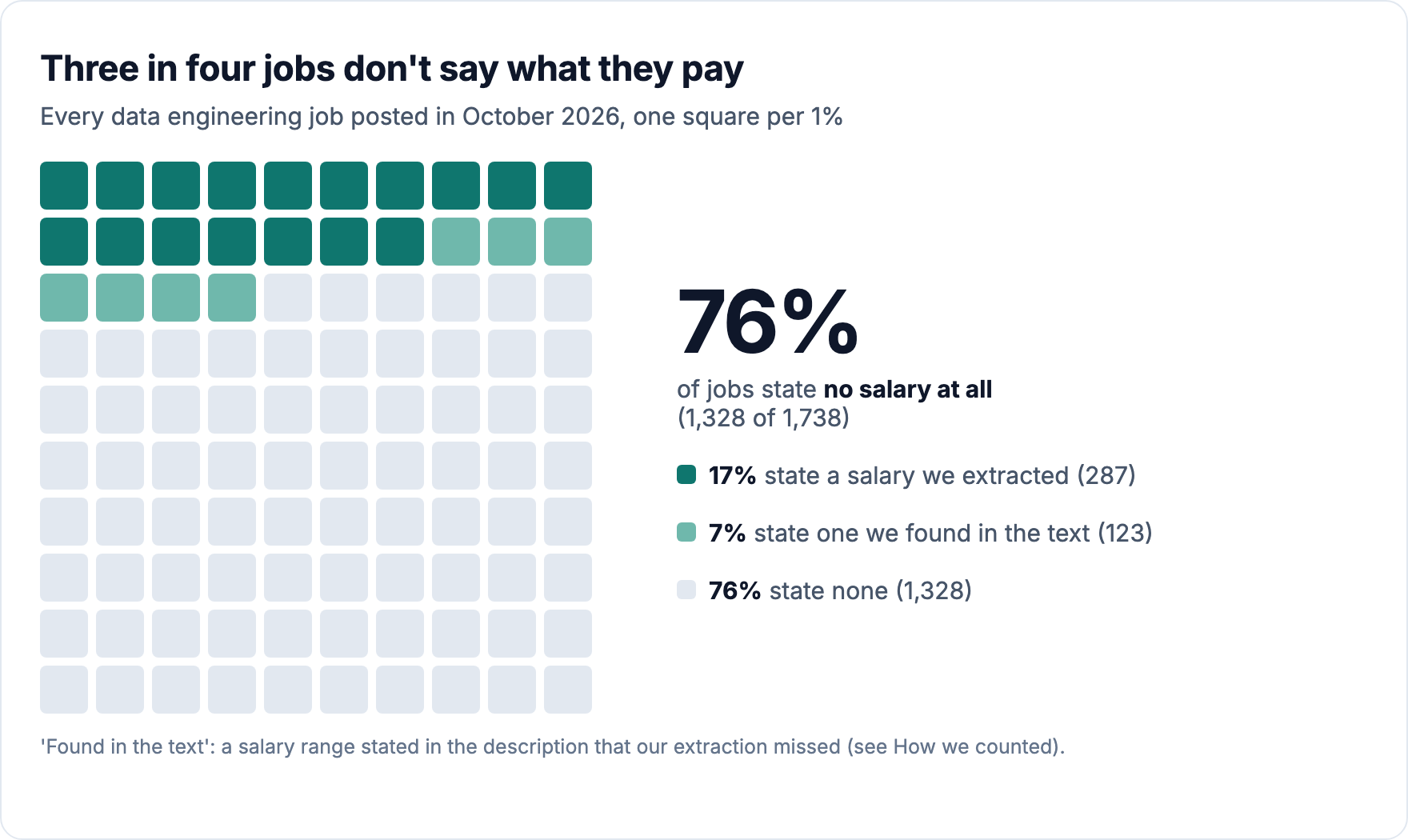
Only 410 of 1,738 jobs (24%) state a salary. The other 1,328 give no figure at all: no range, no “from”, no “up to”.
Silence is the norm for most employers. Of the 730 companies that posted in October, 510 (70%) didn’t state pay in a single one of their jobs, and 189 stated it in all of them. Some of the largest posters stated pay in none of their jobs, including the consulting and IT services firms CI&T (21 jobs), Sia (21), Talan (19) and Endava (16). Others stated pay every time: Raydar (20 of 20) and Anthropic (11 of 11).
Whether you see the pay depends on where the job is
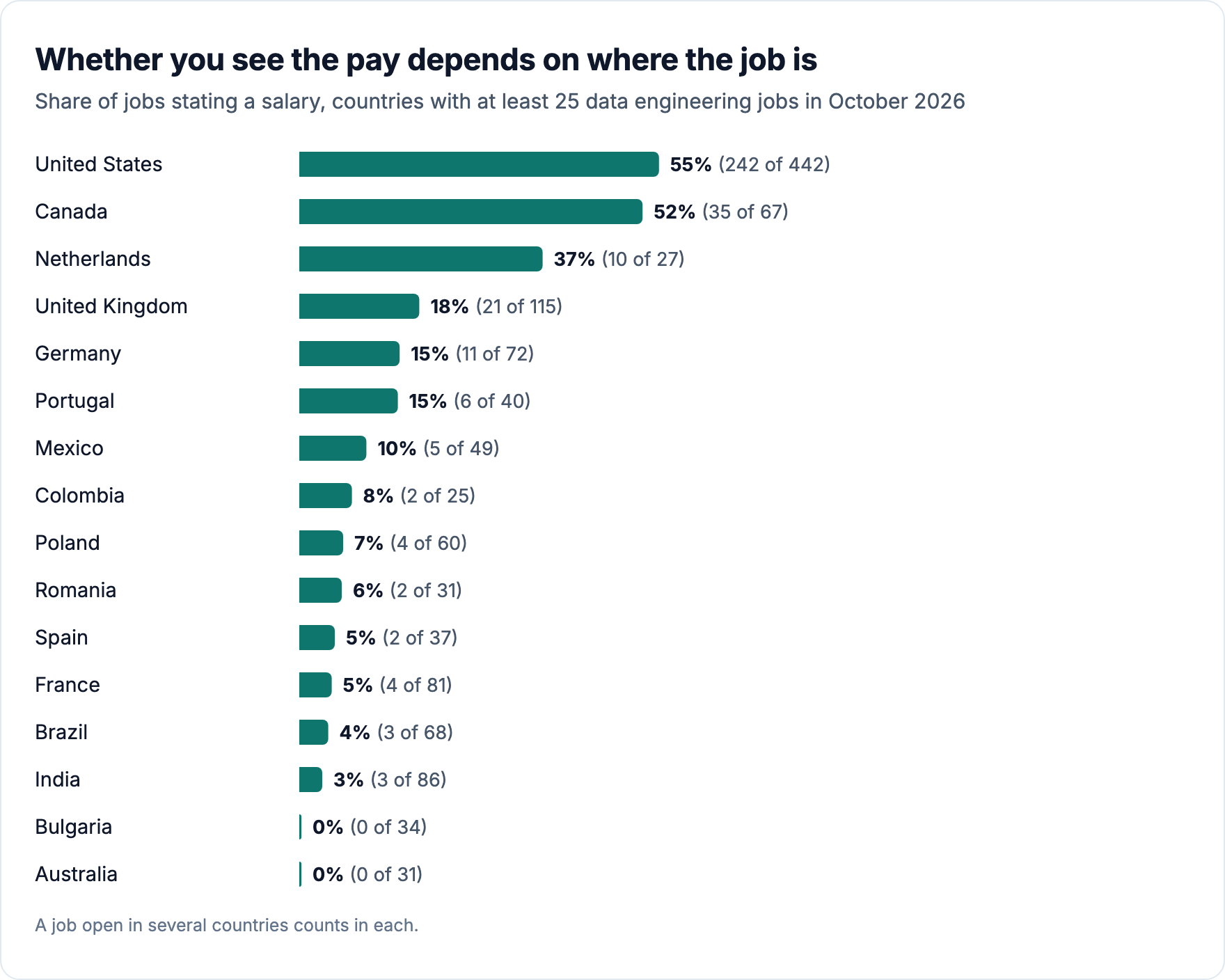
Pay transparency is mostly a North American habit:
- US (55%) and Canada (52%) state pay in more than half of their jobs. In Canada, British Columbia and Ontario now require pay ranges in public job postings.
- The Netherlands (37%) is the European exception.
- Elsewhere in Europe it’s rare: the UK 18%, Germany 15%, France and Spain 5% each. The EU Pay Transparency Directive was due to be written into national law by June 2026. It lets employers give the pay range either in the job ad or before the interview, so it hasn’t yet shown up in job ads.
- In Brazil (4%), India (3%), Bulgaria and Australia (0%), a stated salary is almost unheard of.
In the US, the law makes the difference
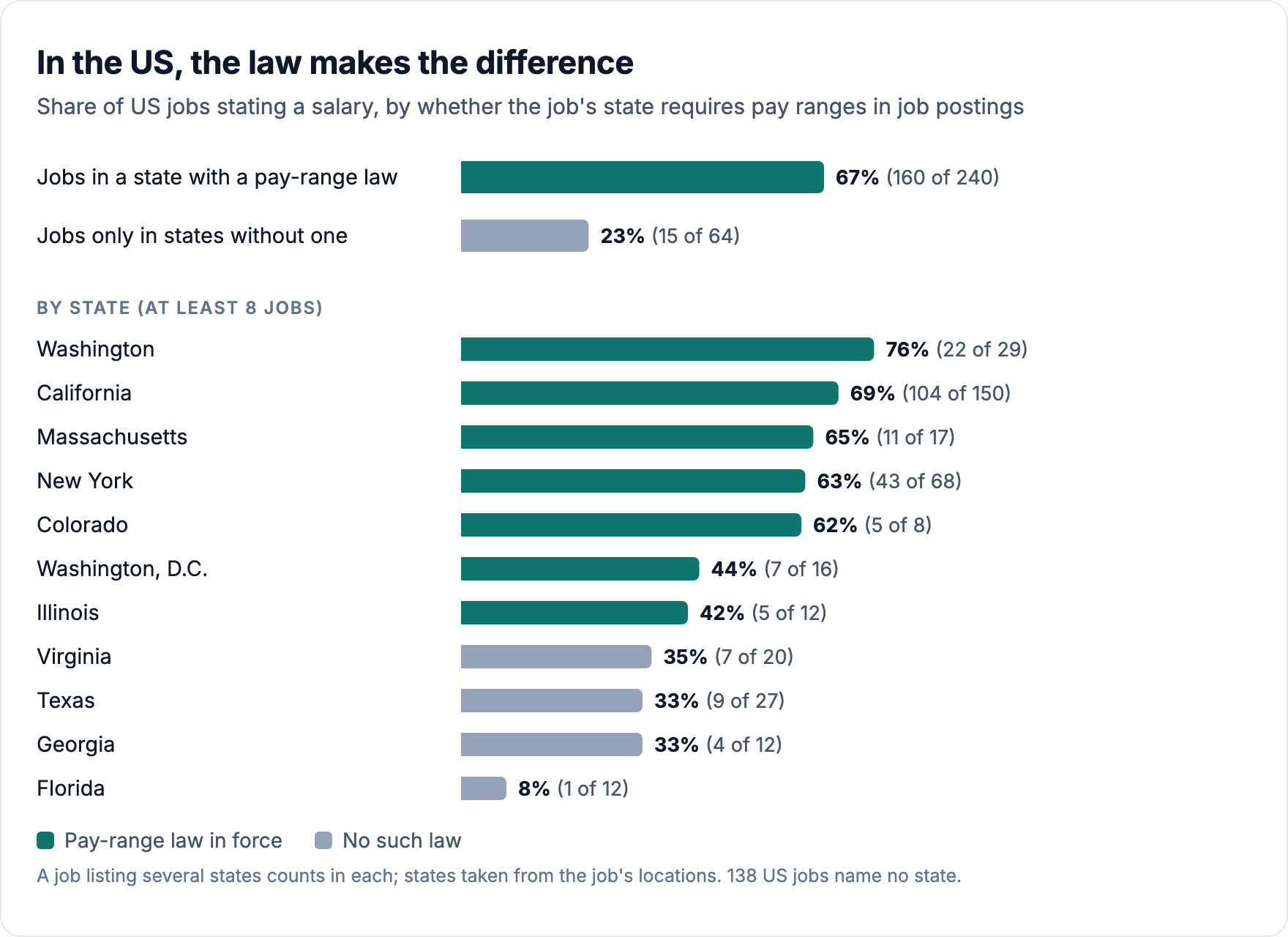
Several US states and Washington, D.C. now require employers to put a pay range in job postings. Among them are California, Colorado, Washington, New York, Illinois, Massachusetts, Minnesota, New Jersey, Maryland, Hawaii and Vermont. The effect is easy to see:
- Jobs located in at least one such state state a salary 67% of the time. Washington (76%) and California (69%) lead.
- Jobs located only in states without such a law state one 23% of the time. Florida is lowest at 8% (1 of 12).
- Even in those states, a third of jobs show no range in the description we collected. Some may show it elsewhere on the employer’s site, and some laws exempt small employers.
Texas (33%) and Virginia (35%) do far better than Florida. Even counting only jobs located solely in Texas or Virginia, about 30% state pay (6 of 20 and 5 of 18).
Who states the pay
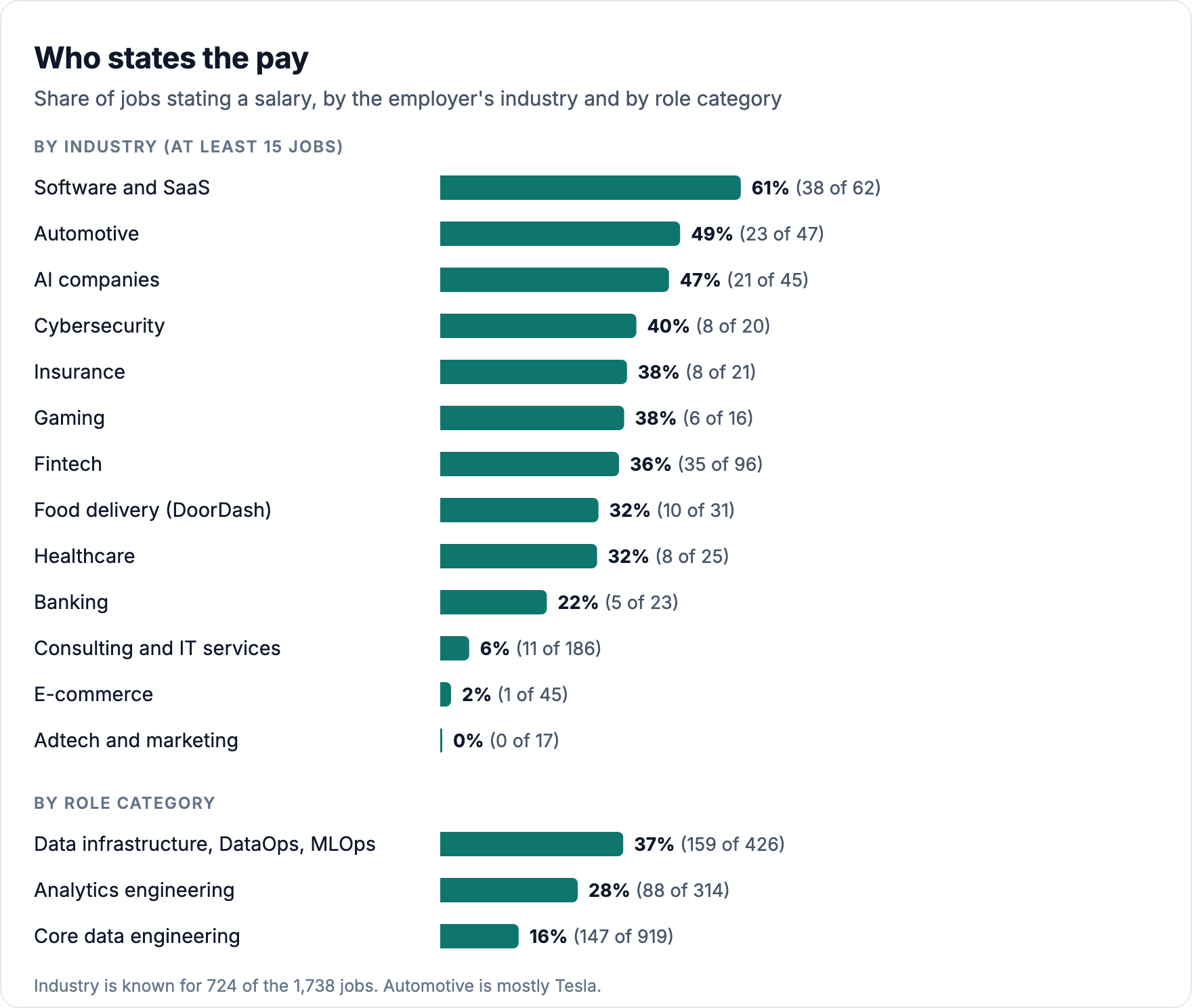
- Software and AI companies state pay most often: SaaS 61%, AI companies 47%. Nearly half of their jobs are in the US (45% and 42%).
- Consulting and IT services almost never do (6%), and neither do e-commerce employers (2%). Both hire mostly in Europe: 139 of 186 consulting jobs and 26 of 45 e-commerce jobs.
- Platform and MLOps jobs state pay far more often than core data engineering ones (37% against 16%). They’re also more often in the US (31% of them, against 22% of core jobs).
- Seniority matters too. Principal (40%) and staff (34%) jobs state pay more often than senior (23%) or junior (20%) ones. Internships almost never do (1 of 23).
What the jobs that state a salary pay
The pay figures below use the 287 salaries we extracted with their currency and period. Contractor rates (6 jobs) are left out. Each range is annualized where needed (monthly × 12, hourly × 2,080).
- Currency: 201 of these salaries are in US dollars, 42 in euros, 16 in Canadian dollars and 15 in pounds.
- Period: most are yearly (255). Monthly salaries (26) are common in continental Europe and Latin America, and a few are hourly (6).
United States by level
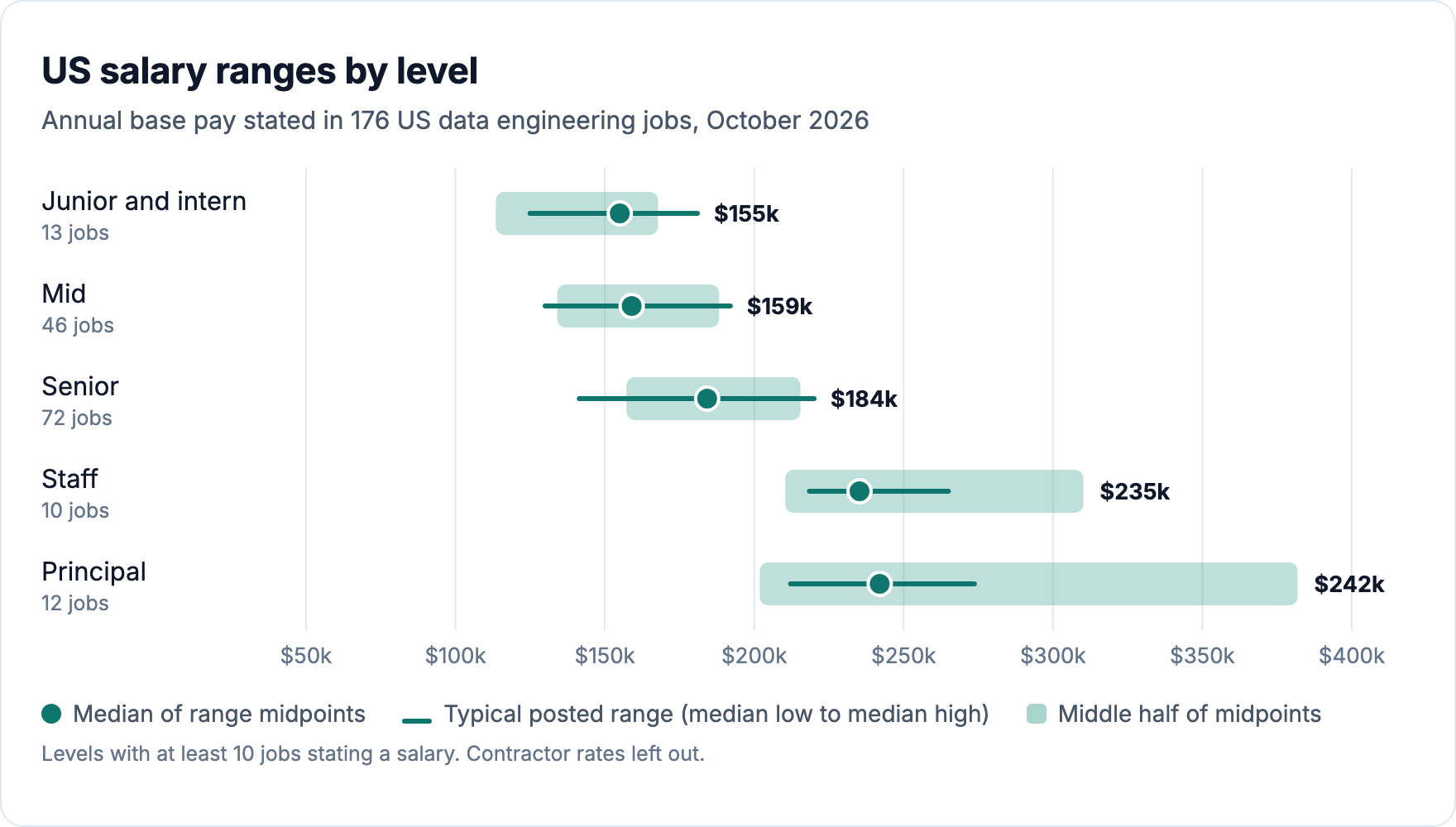
| US, annual base | Jobs | Typical range (median low – median high) | Median midpoint | Middle half of midpoints |
|---|---|---|---|---|
| Junior and intern | 13 | $125k – $181k | $155k | $114k – $168k |
| Mid | 46 | $130k – $192k | $159k | $134k – $188k |
| Senior | 72 | $141k – $220k | $184k | $157k – $216k |
| Staff | 10 | $218k – $265k | $235k | $210k – $310k |
| Principal | 12 | $212k – $274k | $242k | $202k – $382k |
| All US jobs | 176 | $145k – $216k | $180k | $150k – $220k |
Three things to know when reading this:
- The big jump is from senior to staff. Junior and mid pay is close ($155k against $159k), and senior adds about $25k. Staff adds another $50k.
- The junior figure isn’t typical of the whole market. Only 13 junior jobs state a salary, mostly at tech companies in California, New York and Washington state (SpaceX, DoorDash, Palantir and several startups).
- The top is very high, but rare. The highest ranges came from Netflix (a midpoint of $614k for a manager, $448k for a senior engineer) and Anthropic ($403k for staff and principal roles). The lowest midpoints were around $88k.
By kind of role, US platform and MLOps jobs pay a median of $210k (73 jobs). Core data engineering ($165k, 61 jobs) and analytics engineering ($166k, 36 jobs) pay almost the same. Remote US jobs pay much the same as on-site and hybrid ones ($184k against $176k).
How wide the ranges are
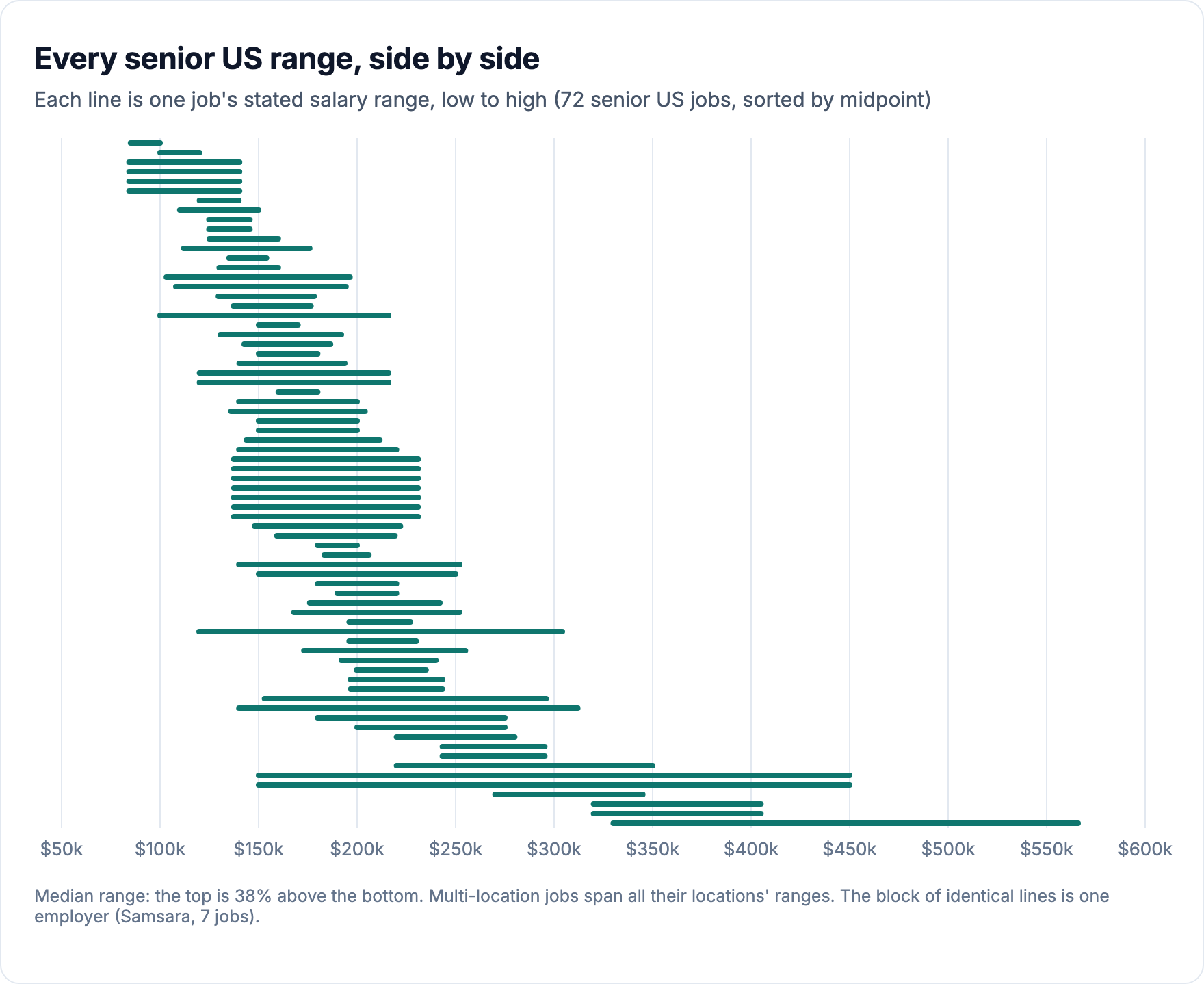
A posted range is an envelope, not an offer:
- Typical width: in the median stated range the top is 35% above the bottom (e.g. $150k–$203k). The middle half of ranges are 22–55% wide, and 35% of ranges are at least 1.5× wide.
- Multi-location jobs are the widest, because one posting covers pay in several cities. A range like $150k–$450k says more about the spread of locations than about any single offer.
- Ranges are the norm: 278 of the 287 salaries give both ends, 9 give only a minimum (“from”), and 15 jobs list separate ranges by location or level.
Other countries, in their own currency
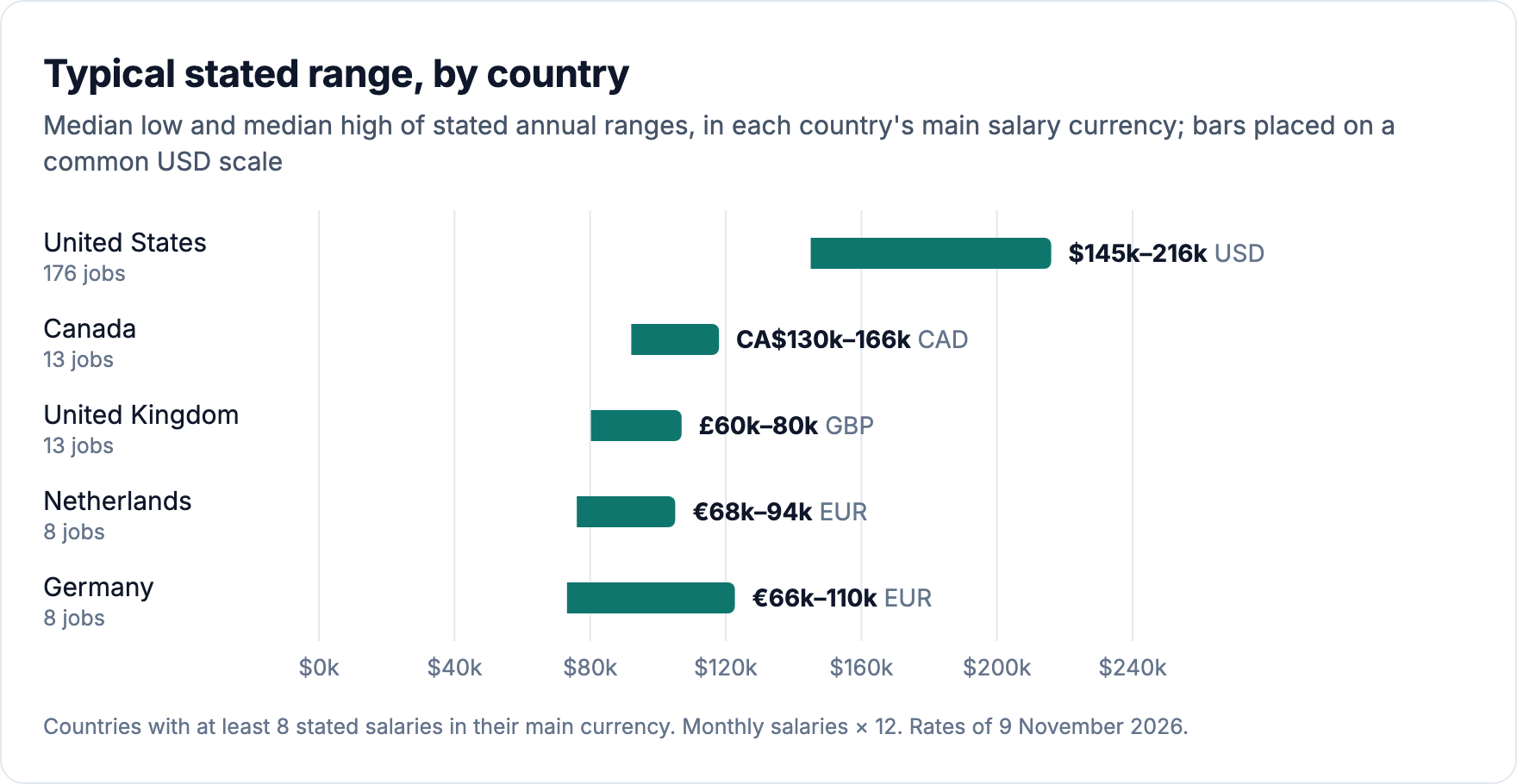
| Country | Jobs stating a salary | Currency | Typical range | Median midpoint |
|---|---|---|---|---|
| United States | 176 | USD | $145k – $216k | $180k |
| Canada | 13 | CAD | CA$130k – CA$166k | CA$149k |
| United Kingdom | 13 | GBP | £60k – £80k | £67.5k |
| Netherlands | 8 | EUR | €68k – €94k | €79k |
| Germany | 8 | EUR | €66k – €110k | €74k |
These samples are small. Because so few European and Asian jobs state pay, we can’t give reliable figures for France, Spain, Poland, India or Brazil this month. In the UK, the middle half of midpoints runs from £54k to £109k: the top end comes from fintech and AI companies (Wise, Microsoft AI, Raydar).
Comparing across currencies at today’s rates, the typical US range ($145k–216k) is roughly twice the UK’s (£60k–80k, about $80k–107k) and well above Germany’s and the Netherlands’ (around $74k–123k and $76k–105k). Remember the selection, though: a stated salary is the norm in the US and the exception in Europe, so these figures describe different slices of each market.
What to take from this
- If you’re job hunting outside North America, expect to ask. In most countries fewer than one job in five states pay, so the first conversation is where you find out. Use the figures above as a starting point.
- In the US, a missing range is itself information. Jobs in pay-range-law states usually state one. If a job based in one of those states doesn’t, it’s worth asking why.
- Read a range by its location. Multi-location ranges are wide by design, so ask which part of the range applies where you’d work.
To see only jobs that state their pay, use the salary filter when you browse jobs. The weekly Digest puts the jobs that state their salary and stack first.
How we counted
- What’s included: jobs whose employer-stated posting date falls in October 2026 and that passed our moderation as genuine data engineering roles. Jobs that have since closed are included. A job posted on several sites counts once.
- Stating a salary: a job counts as stating a salary if we extracted one (287 jobs), or if its description states a salary range next to words like “salary”, “compensation” or “pay range” that our extraction missed (123 jobs). Most of those missed ranges didn’t say “per year”, and our extraction dropped salaries without a stated period. We’ve fixed this for new jobs; the 123 are counted here from the text. Because the text check looks only for explicit ranges, the true share stating a salary may be slightly higher than 24%.
- Pay figures: only the 287 extracted salaries, which have a known currency and period. Each range is annualized (hourly × 2,080, daily × 260, monthly × 12) and summarized by its midpoint. Contractor rates are left out. Currency conversions use the rates of 9 November 2026.
- US states: taken from each job’s listed locations. A job listing several states counts in each, and 138 US jobs name no state. The state laws named are those in force in October 2026 that require a pay range in job postings.
- Coverage: these are the jobs our sources reach: company career pages, ATS boards, job boards and Hacker News “Who’s Hiring”. It isn’t the whole market. LinkedIn and Indeed, for example, aren’t included.
For what employers ask for alongside the pay, see The Data Engineering Stack Employers Actually Ask For: October 2026 and Data Engineer vs Analytics Engineer vs Data Platform Engineer.