 get
Data Engineer vs Analytics Engineer vs Data Platform Engineer: How the Job Descriptions Differ
What 1,145 job descriptions from October 2026 say about how Data Engineer, Analytics Engineer and Data Platform Engineer roles differ in work, tools and pay.
By Adyl · · 13 min read
Three job titles now cover most of the data engineering market: Data Engineer, Analytics Engineer and Data Platform Engineer. They sound similar, they’re often on the same team, and every job description says “build data pipelines”. So what’s actually different?
We read the job descriptions to find out. Among the 1,738 data engineering jobs posted in October 2026 that passed our moderation, 1,145 use one of these three titles:
- Data Engineer: 828 jobs at 435 companies, including Senior Data Engineer, Big Data Engineer and the like.
- Analytics Engineer: 201 jobs at 147 companies.
- Data Platform Engineer: 116 jobs at 83 companies, counting any title that combines “data” and “platform”, such as Software Engineer, Data Platform.
For each job we compared four things: the work the description asks for, the tools it names, the languages, and the level and pay.
The short version
- Data Engineers move and shape data. Pipelines appear in 96% of their descriptions. Spark is the top tool, named in 46% of these jobs and required in 81% of those.
- Analytics Engineers turn data into trusted models and metrics. Their descriptions talk about data modelling (82%), dashboards (83%) and stakeholders (82%). dbt is named in 71% of their jobs, and 57% mention metrics, KPIs or semantic layers.
- Data Platform Engineers build what everything else runs on. They’re the only ones regularly asked to build tools for other engineers (40%) or take part in on-call and incident response (38%). Terraform (33%) and Kubernetes (26%) rank among their top tools.
- Titles don’t always match the work. 40 “Data Engineer” jobs (5%) are really analytics engineering, and Data Platform Engineer jobs split across all three role categories.
Where each role sits
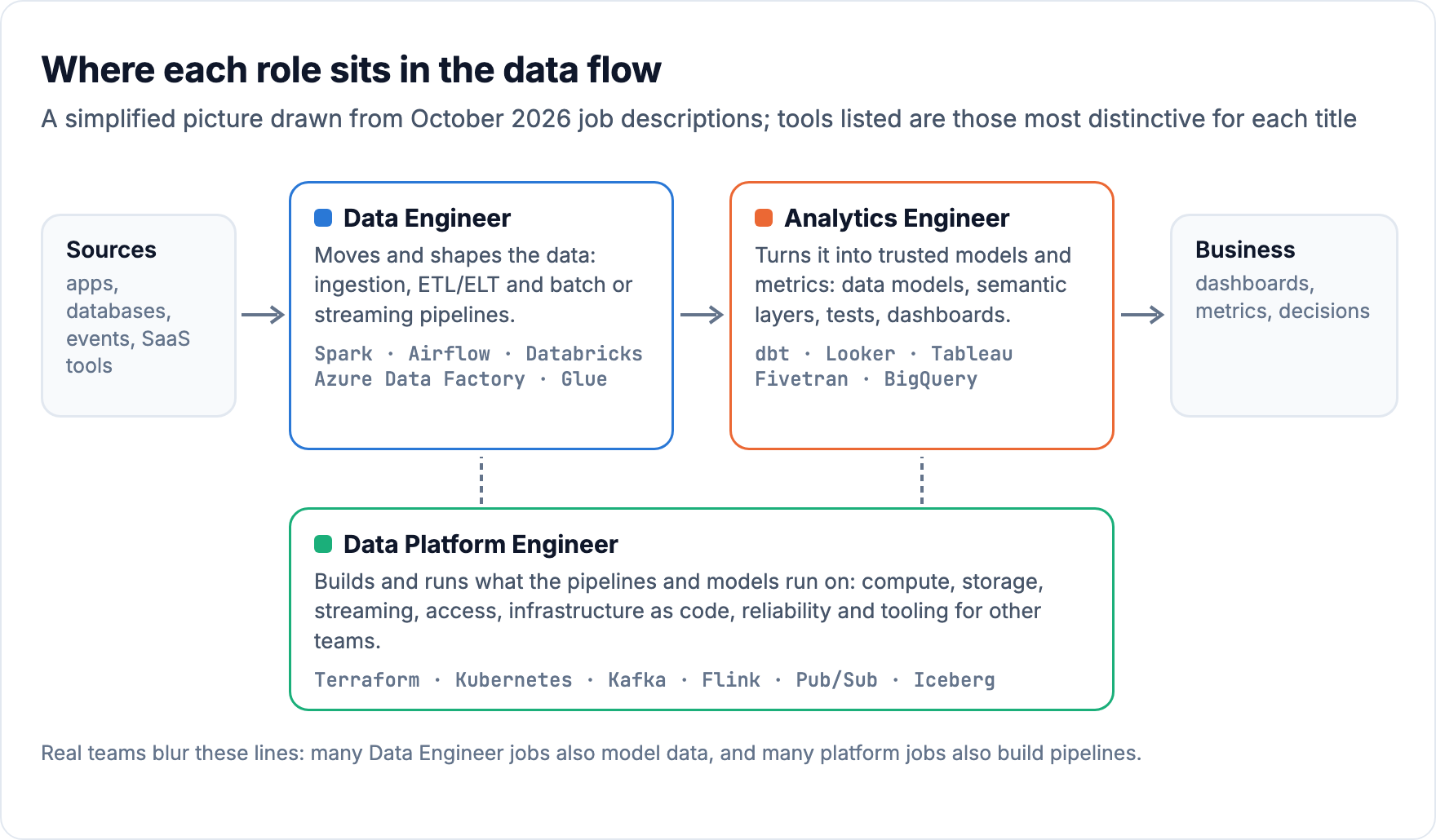
In one sentence each:
- A Data Engineer gets data from where it’s produced to where it’s needed, in good shape.
- An Analytics Engineer turns that data into models and metrics the business can trust and use without asking an engineer.
- A Data Platform Engineer builds and runs the infrastructure both of them work on, and treats the other engineers as their customers.
Real teams blur these lines. A Data Engineer at a small company often does all three jobs. The differences below are about where each title puts its weight, not hard boundaries.
What the job descriptions ask you to do
We searched every English-language description for families of phrases describing a kind of work. For example, “Infrastructure as code” covers Terraform, IaC, Pulumi and CloudFormation.
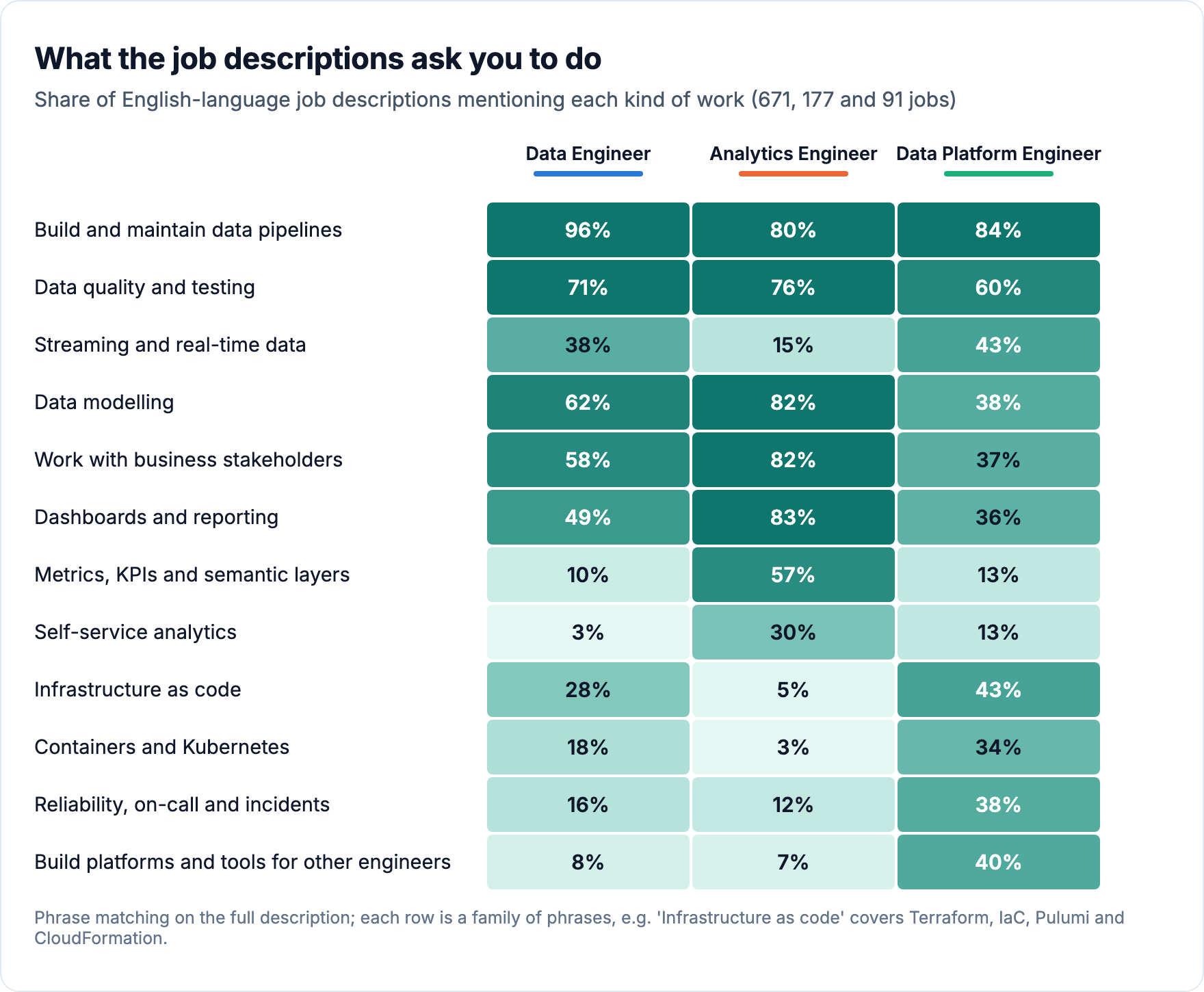
What they share. All three build pipelines: 80–96% of descriptions mention them. All three care about data quality and testing (60–76%). If you can build a reliable pipeline and test it, you have the foundation for any of these jobs.
Where the Analytics Engineer stands apart: the business side.
- Data modelling (82%), dashboards and reporting (83%) and working with stakeholders (82%) appear in most Analytics Engineer descriptions.
- Metrics, KPIs and semantic layers appear in 57% of them, against 10–13% for the other two titles.
- 30% mention self-service analytics, meaning data people outside the data team can use on their own.
- Infrastructure barely registers: infrastructure as code (5%) and Kubernetes (3%) are almost absent.
Where the Data Platform Engineer stands apart: operations and internal customers.
- 40% of descriptions mention building platforms or tools for other engineers (“developer experience”, “platform capabilities”, “internal tools”). For the other two titles it’s 7–8%.
- 38% mention on-call, SLAs or incident response, more than twice as often as the others.
- Infrastructure as code (43%) and containers (34%) are part of the job.
- Data modelling (38%) and stakeholders (37%) come up less often than for either other title.
The Data Engineer sits in between, closer to the platform side. Data Engineers model data (62%) and work with stakeholders (58%) less than Analytics Engineers do. They handle infrastructure as code (28%) and streaming (38%) more than Analytics Engineers but less than platform engineers. That fits the role: Data Engineer is the broadest title of the three.
The phrases that give each title away
Another way to see the difference is to look for phrases that are common in one title’s descriptions and rare in the others:
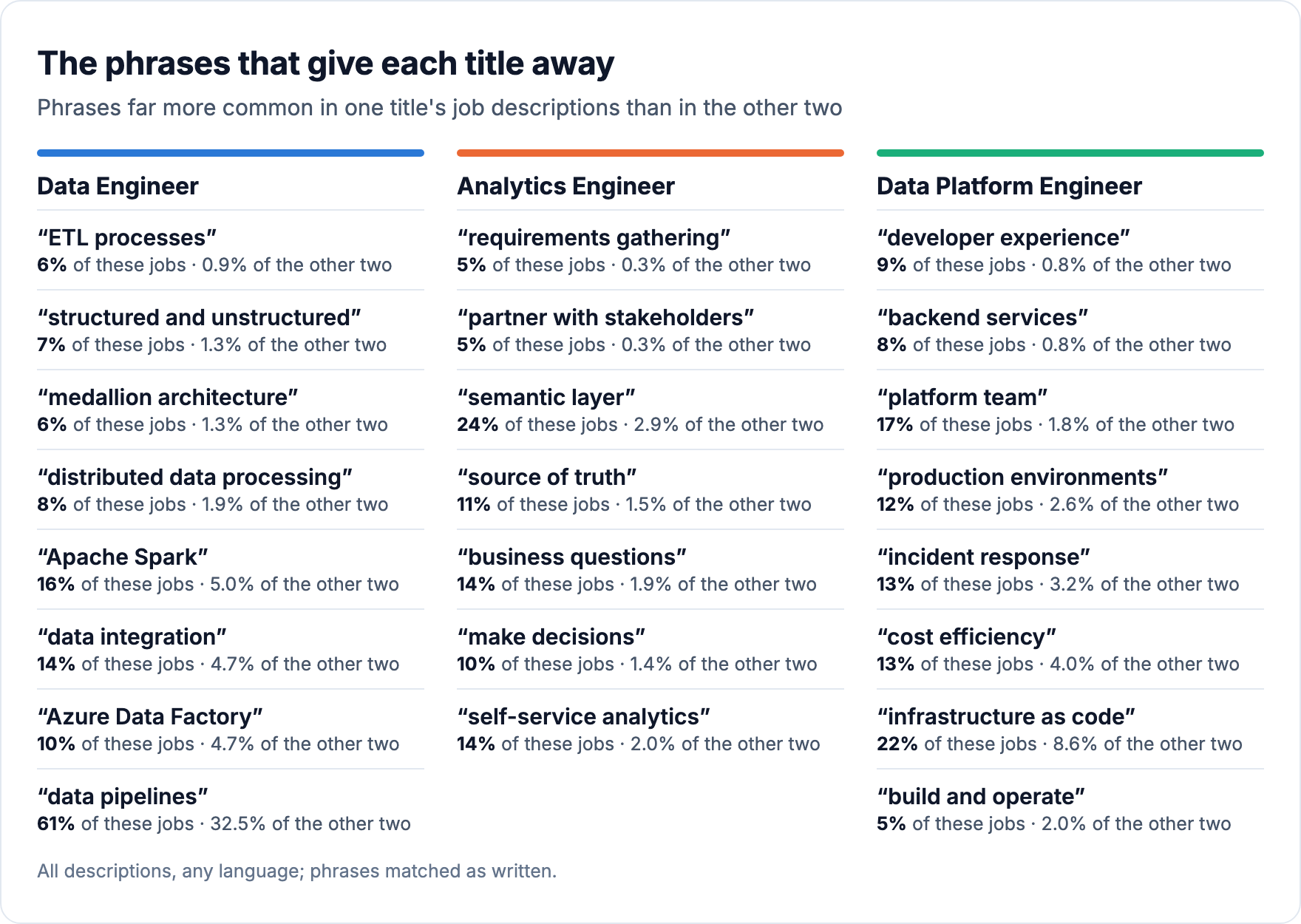
The vocabulary tells the story:
- Data Engineer descriptions talk about processing data: ETL processes, distributed data processing, data integration, structured and unstructured data, and the medallion architecture of Databricks lakehouses.
- Analytics Engineer descriptions talk about the business: the semantic layer (24% of them), a single source of truth, answering business questions and helping people make decisions.
- Data Platform Engineer descriptions talk about operating software for other engineers: the platform team, developer experience, backend services, production environments, incident response and cost efficiency.
The tools behind each title
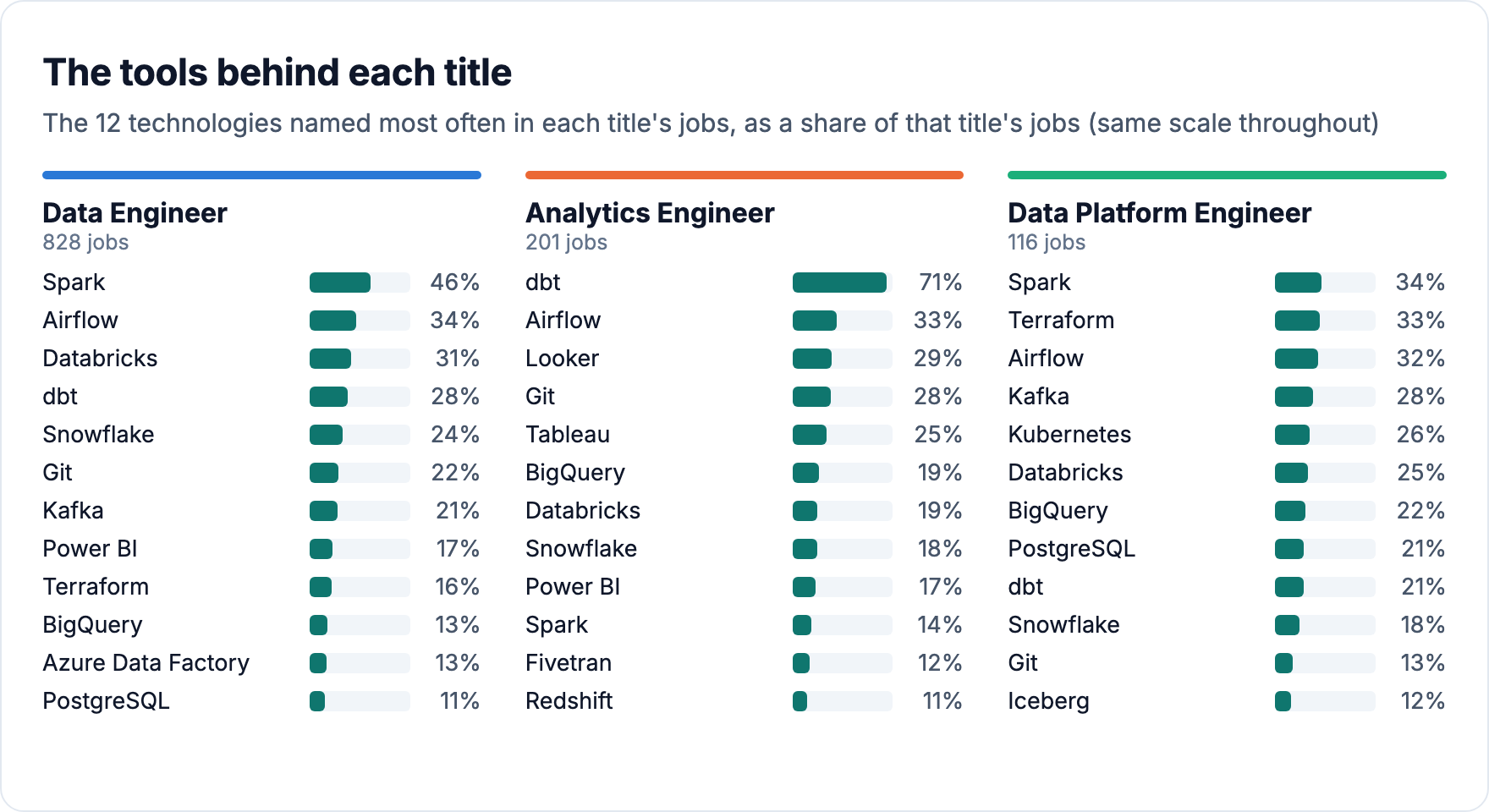
- Data Engineer: Spark and the cloud ETL services. Spark leads (46%) and is required in 81% of the Data Engineer jobs that name it. Compared with the other two titles, the tools that stand out are the managed services of the big clouds: Azure Data Factory, AWS Glue, Microsoft Fabric, Redshift and SQL Server.
- Analytics Engineer: dbt and BI tools. dbt is in 71% of Analytics Engineer jobs, and required in 78% of those. Nearly half (46%) name a BI tool (Looker, Tableau or Power BI), twice the Data Engineer share and five times the platform share. Spark (14%) matters little. Analytics Engineers are also the most likely to be asked about AI coding assistants: 13% of their jobs name Claude Code, Cursor or Claude, against 6–8% for the other two titles.
- Data Platform Engineer: infrastructure and streaming. Terraform (33%) and Kubernetes (26%) sit next to the data tools. Kafka (28%), Flink, Pub/Sub, Kinesis and Iceberg are more common here than anywhere else. When Terraform appears in a platform job, it’s required 74% of the time.
Airflow is the common ground. It’s named in about a third of jobs under every title (32–34%), the only tool that ranks so evenly. Learn it once and it carries over.
Languages and clouds
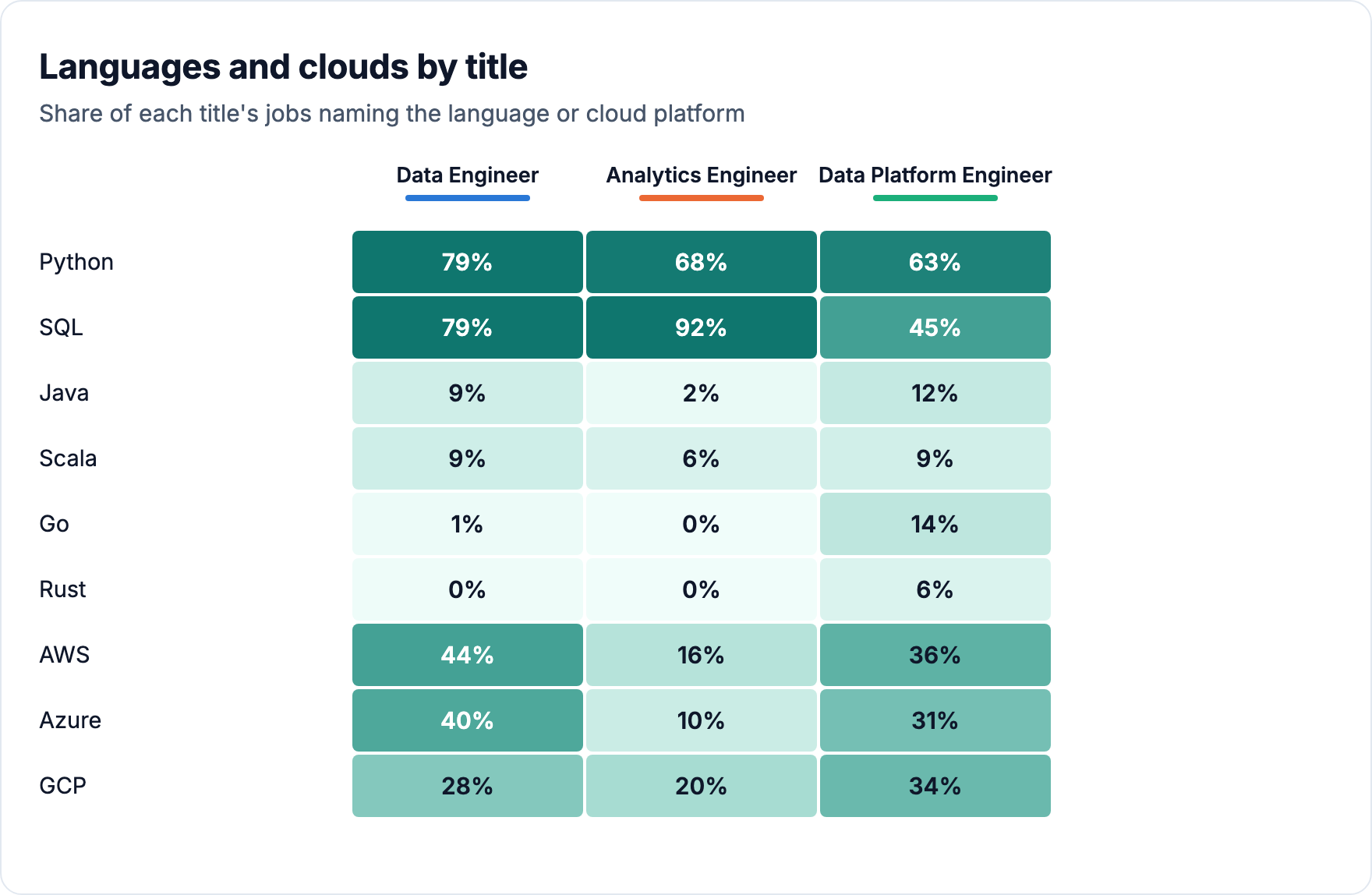
- SQL separates the analytics side from the platform side. It’s named in 92% of Analytics Engineer jobs and only 45% of Data Platform Engineer jobs.
- Go appears almost only in platform jobs (14%), as do Rust (6%) and the highest share of Java (12%). Data Engineers lean on Python and SQL (79% each), with Java and Scala at 9%.
- Analytics Engineers rarely name a cloud. AWS (16%), Azure (10%) and GCP (20%) all appear far less than for the other titles, because the warehouse and dbt hide the cloud underneath. Data Engineers name AWS (44%) and Azure (40%) most often.
Level, remote work and pay
| Data Engineer | Analytics Engineer | Data Platform Engineer | |
|---|---|---|---|
| Jobs (companies) | 828 (435) | 201 (147) | 116 (83) |
| Junior or intern | 8% | 8% | 1% |
| Senior, lead, staff or principal | 57% | 58% | 60% |
| Can be done remotely | 30% | 41% | 28% |
| Technologies named, on average | 5.5 | 4.2 | 5.4 |
| US jobs stating a salary | 60 | 24 | 9 |
| US median salary | $161k | $162k | $212k |
| US middle half | $134k–199k | $112k–184k | $179k–252k |
- Data Platform Engineer is hardly ever an entry-level title. Only 1 of 116 jobs is junior or an internship. The other two titles each have 8% at those levels. 60% of platform jobs are senior or above, and most of the rest (22%) don’t state a level.
- Analytics Engineer is the most remote-friendly title: 41% of these jobs can be done remotely, against 28–30% for the other two.
- Data Engineer and Analytics Engineer pay about the same in the US ($161k against $162k), and so do their senior roles ($170k against $176k). Analytics Engineer pay is more spread out: its lower quartile is $22k lower.
- Data Platform Engineer pay looks higher, but treat it as a hint. It rests on just 9 US jobs with a stated salary ($212k median). That’s consistent with the senior, infrastructure-heavy profile, but too few jobs to rely on.
Where the titles are used varies by country. Analytics Engineer accounts for 26% of jobs in Germany and 24% in Brazil, against 13% in the US and 11% in the UK and France. Data Platform Engineer is most common in France (11%) and barely used in Brazil (1%).
The title doesn’t always match the job
We classify every job into one of three role categories from its full description, not its title. The categories come from our scope definition: core data engineering, analytics engineering / data platform, and data infrastructure / DataOps / MLOps. Comparing them with the titles employers chose shows how loosely the titles are used:
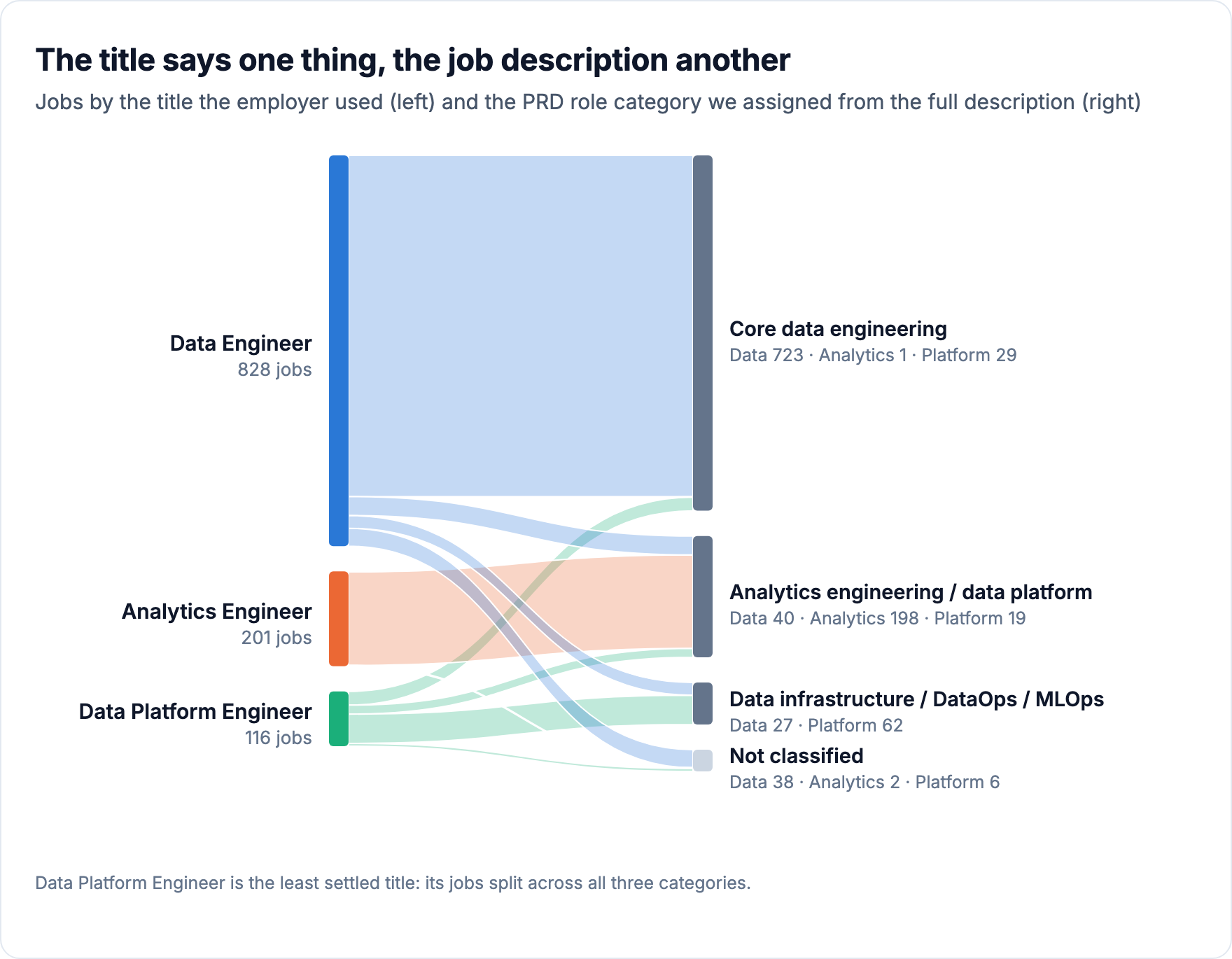
- Analytics Engineer is the most reliable title. 198 of its 201 jobs are exactly what the title says.
- Data Engineer is reliable, with exceptions. 87% of these jobs are core data engineering. But 40 (5%) are analytics engineering work under a Data Engineer title, and 27 (3%) are infrastructure or MLOps roles.
- Data Platform Engineer means different things at different companies. Just over half of these jobs (62) are infrastructure, DataOps or MLOps work. A quarter (29) are core data engineering roles that build pipelines on “the data platform”. 19 are analytics-platform roles centred on the warehouse and BI layer.
If you’re applying for a Data Platform Engineer job, read the description to find out which of these three jobs it is. The quickest tell is whether it mentions Terraform, Kubernetes and on-call, or dbt, Looker and stakeholders.
Which one is for you?
- You like the business questions: go for Analytics Engineer. Learn SQL deeply, dbt, data modelling and one BI tool. It’s the most remote-friendly of the three and as open to juniors as Data Engineer.
- You like building data systems end to end: go for Data Engineer. Learn Python, SQL, Spark, Airflow and one cloud’s data services. It’s the biggest market by far (828 of the 1,145 jobs) and has the most entry-level openings (66 junior jobs and internships).
- You like infrastructure and building for other engineers: go for Data Platform Engineer, usually as a second step. Add Terraform, Kubernetes, a streaming system such as Kafka and some Go, and expect on-call. Almost no one starts here, but it’s where the senior, infrastructure-heavy jobs are.
Browse current jobs: analytics engineering, data platform, or all data engineering jobs.
How we counted
- What’s included: jobs whose employer-stated posting date falls in October 2026 and that passed our moderation as genuine data engineering roles. Jobs that have since closed are included. A job posted on several sites counts once.
- Title groups: taken from the employer’s job title. “Analytics Engineer” covers any title containing “analytics engineer”. “Data Platform Engineer” covers any other title containing both “data” and “platform”. “Data Engineer” covers any other title containing “data engineer”. The remaining 593 jobs use other titles, such as Machine Learning Engineer, Software Engineer or ETL Developer, and are left out of the comparison.
- Role categories: assigned from the full description when we assess each job, using the three in-scope categories of our role definition. The comparison with titles is in the last chart.
- Responsibilities: families of English phrases searched in the full description. They’re counted only for English-language descriptions (671, 177 and 91 jobs), because the phrases wouldn’t match other languages. The distinctive-phrases chart uses all descriptions as written.
- Tools, languages and clouds: extracted from each description and normalized, for example “PySpark” counts as Spark.
- Salaries: stated ranges for US jobs, taken at the midpoint as annual base pay in USD, with contractor rates left out.
- Coverage: these are the jobs our sources reach: company career pages, ATS boards, job boards and Hacker News “Who’s Hiring”. It isn’t the whole market. LinkedIn and Indeed, for example, aren’t included.
For more on what employers ask for, see The Data Engineering Stack Employers Actually Ask For: October 2026 and Python, SQL… and What Else?. To get new data engineering jobs every week, subscribe to the weekly Digest.