 get
The State of Data Engineering Jobs in October 2026
What 1,738 data engineering jobs posted in October 2026 say about the stack, remote work, seniority and pay, from Spark and dbt to US salary bands.
By Adyl · · 8 min read
October 2026 was our first full month of collecting, so this is a snapshot, not a trend report. We counted every data engineering job that its employer posted between 1 and 31 October and that passed our moderation: 1,738 jobs at 730 companies, collected from company career pages, ATS boards, job boards and Hacker News, with duplicates merged. About one in five (329) had already closed by 7 November.
Every figure below counts only what the jobs actually say. When a job doesn’t state something, we count it as “not specified” rather than guessing, and we say how many jobs each number rests on.
The short version
- Spark, Airflow and dbt lead the tools, each named by 28–34% of jobs. Python (71%) and SQL (66%) are near-universal.
- Remote is common but not the default: 32% of jobs can be done remotely, 28% are hybrid and 18% on-site; the rest don’t say.
- The market is senior-heavy: 57% of jobs are at senior, lead, staff or principal level, and only 8% are junior or internships.
- Most jobs still hide the pay: only 16% state a salary. In the US it’s 40%, and the median senior salary there is $184k.
- Visa sponsorship is rarely mentioned: 92% of jobs say nothing about it, and of those that do, more say no (98) than yes (40).
What kind of roles
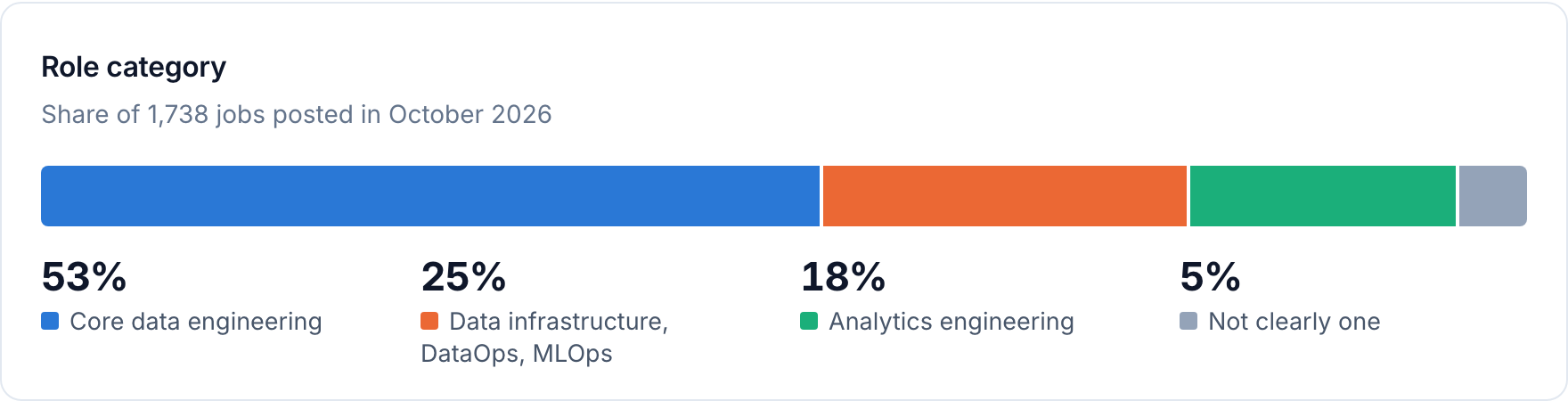
Just over half of the jobs (53%) are core data engineering: pipelines, ETL and warehouses. A quarter (25%) are data infrastructure, platform, DataOps or MLOps roles, and 18% are analytics engineering. The remaining 5% didn’t fit one category clearly.
The stack
90% of jobs name at least one technology, and those that do name about five on average. The most requested, as a share of all 1,738 jobs:
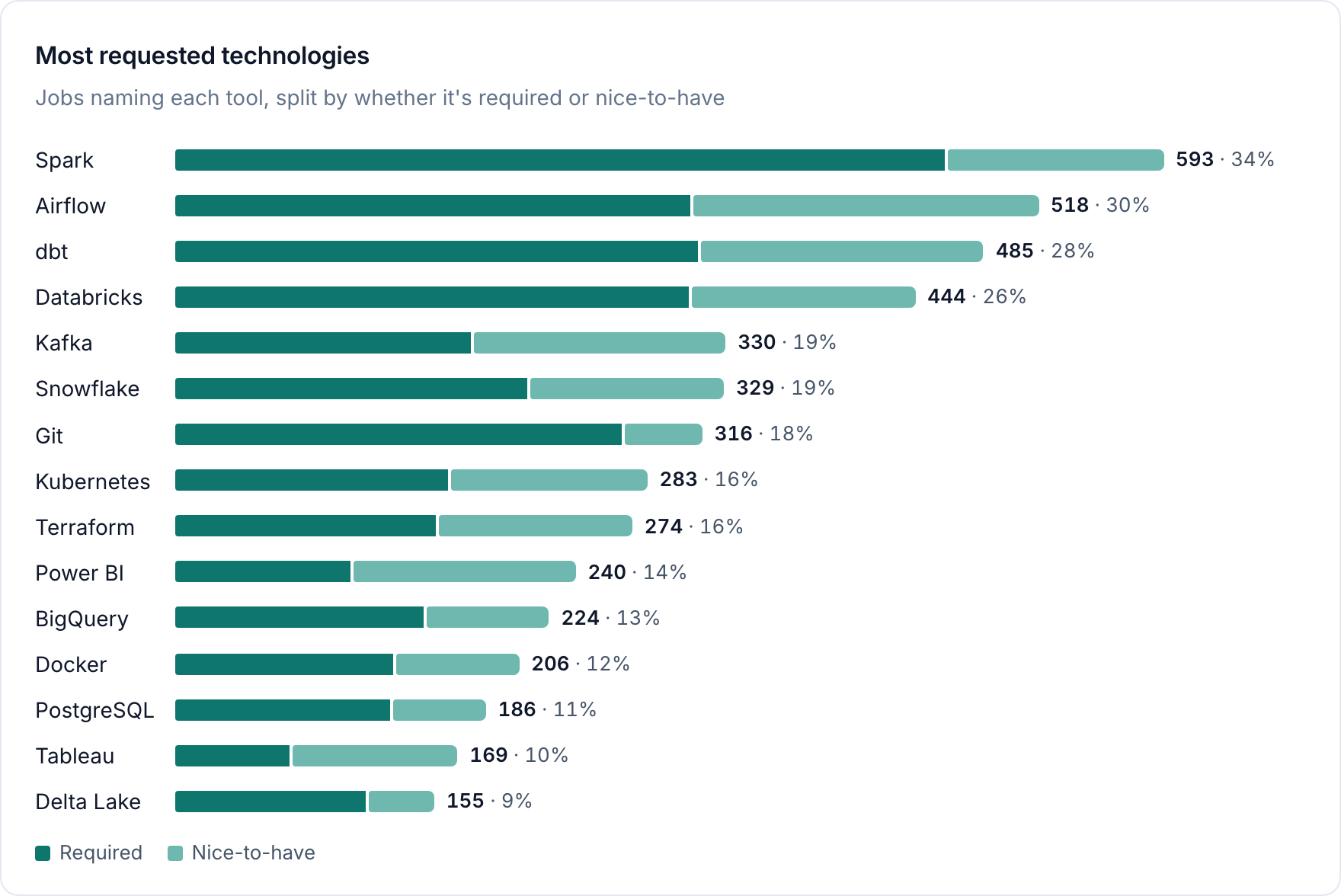
A few things stand out:
- Databricks is ahead of Snowflake (444 jobs against 329). Only 119 jobs ask for both, so most teams have picked one.
- Airflow is still the orchestrator by a wide margin. It appears in 518 jobs, five times as many as Dagster (107).
- Open table formats are now everyday requirements. Delta Lake appears in 155 jobs, Iceberg in 120 and Unity Catalog in 110.
- BI tools show up a lot, usually as nice-to-haves. Power BI (240), Tableau (169) and Looker (125) are named mostly as optional, which fits roles that sit next to analysts.
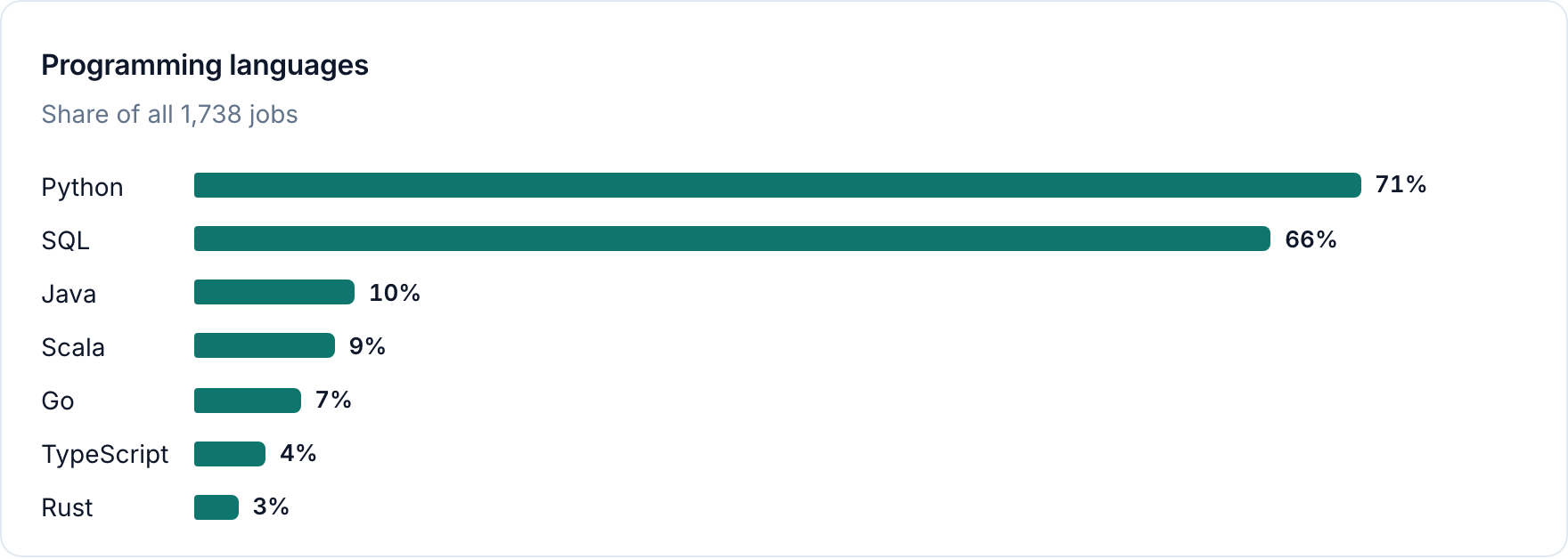
Languages: Python (71%) and SQL (66%) are near-universal. After them come Java (10%), Scala (9%) and Go (7%). Rust appears in 47 jobs.
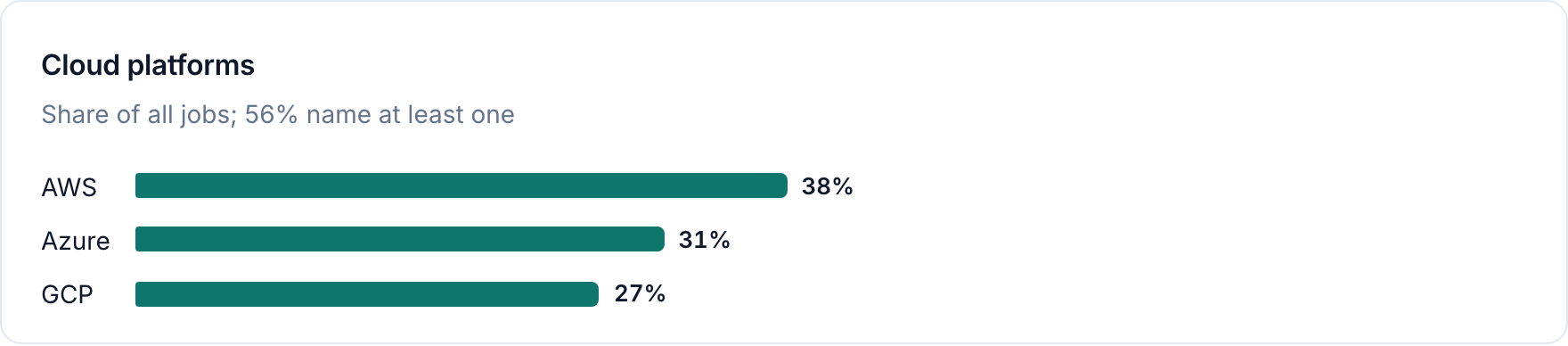
Cloud: 56% of jobs name a cloud platform. AWS leads (38% of all jobs), ahead of Azure (31%) and GCP (27%). Many jobs list more than one.
Where the jobs are
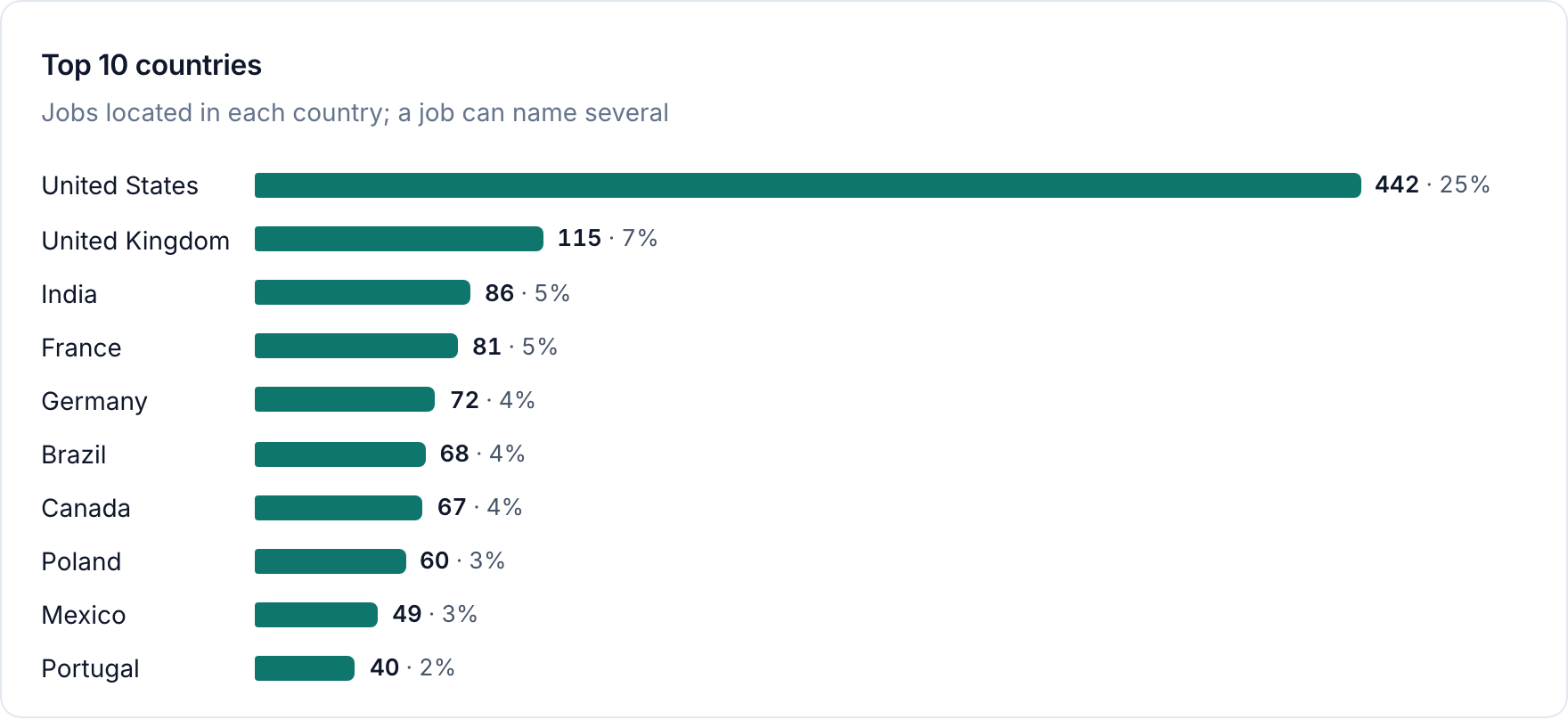
The US accounts for a quarter of all jobs. Europe together outweighs it, but spread over many countries. 84% of jobs are written in English; French (81), Russian (37) and Spanish (36) follow.
Remote, hybrid or on-site
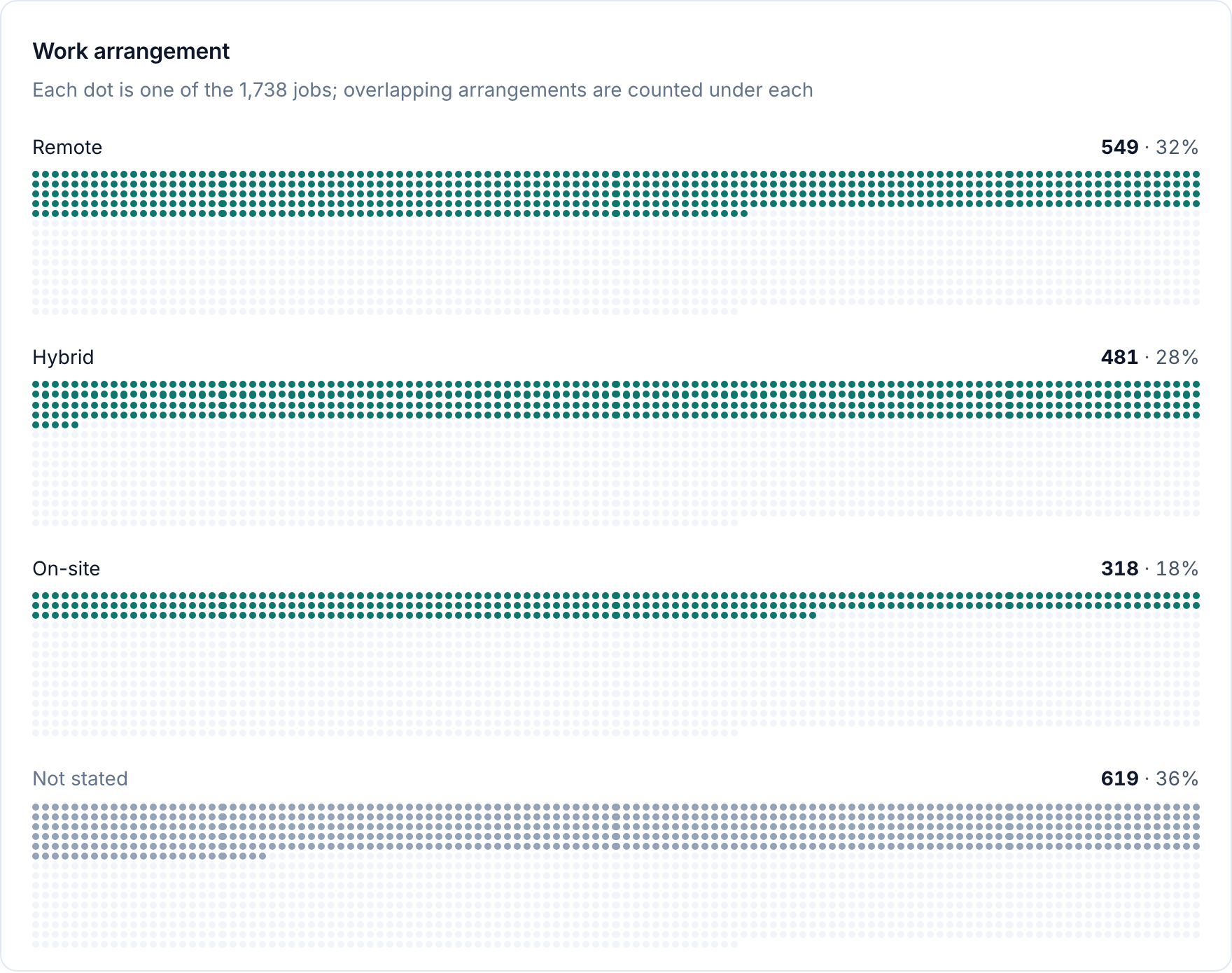
A job can offer more than one arrangement (“remote or hybrid in Berlin”), so these shares overlap:
- Remote: 549 jobs (32%)
- Hybrid: 481 jobs (28%)
- On-site: 318 jobs (18%)
- Not stated: 619 jobs (36%)
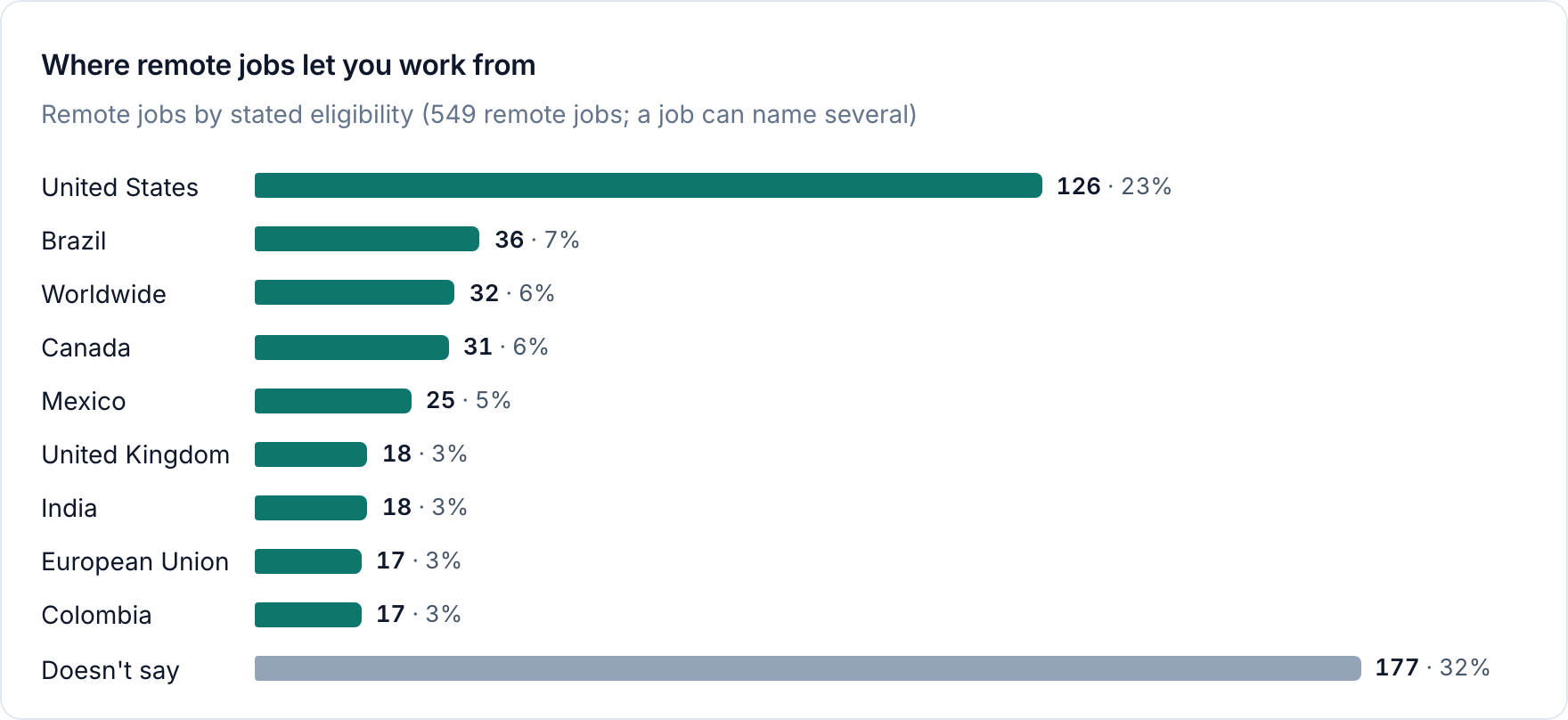
Remote rarely means anywhere: only 32 of the 549 remote jobs are open worldwide. The most common restriction is to the US (126 jobs), then Brazil (36), Canada (31) and Mexico (25). Another 177 remote jobs don’t say where you need to be, so check the description before applying.
Seniority
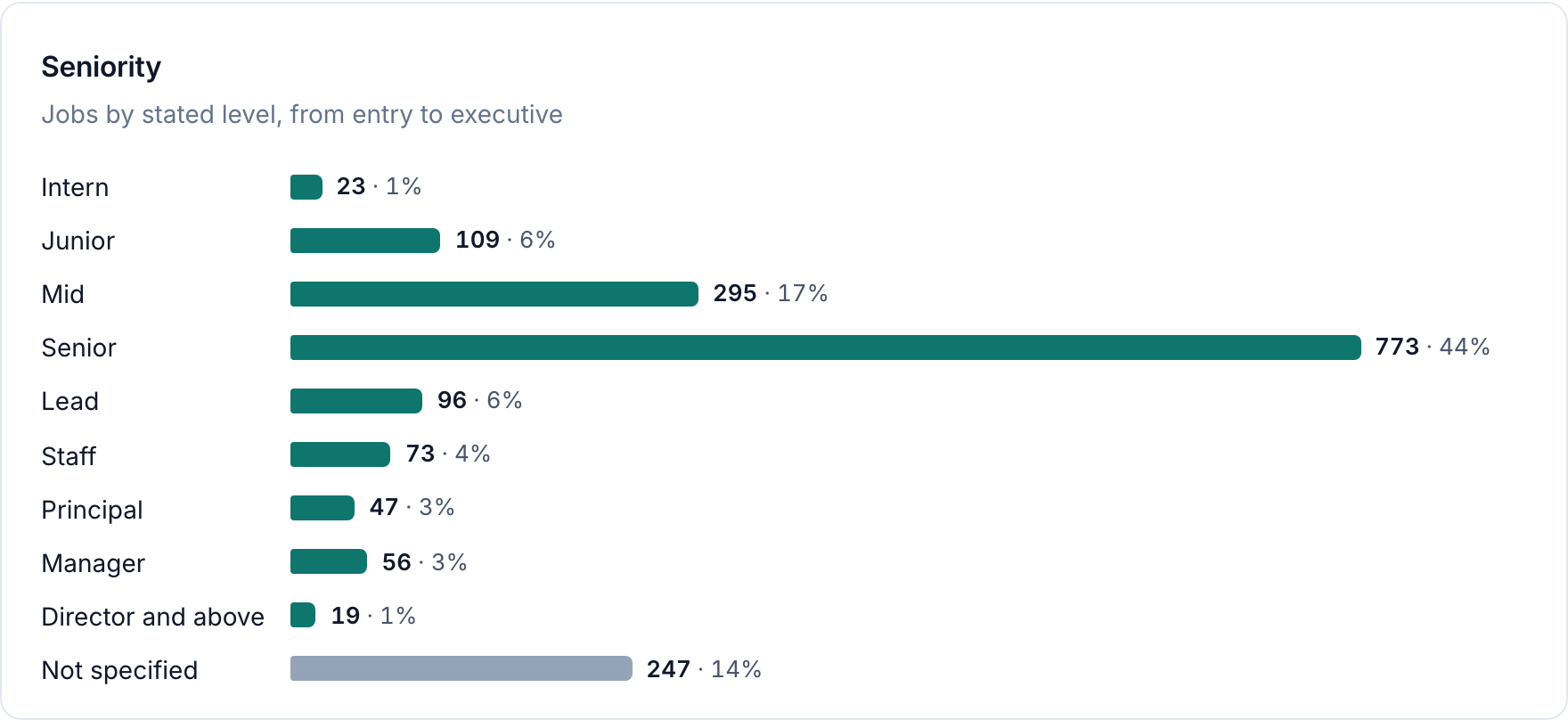
Entry-level roles are scarce: 132 junior and intern jobs, against 989 at senior, lead, staff or principal level. Most junior jobs are core data engineering roles (81), and consulting firms posted more of them (30) than any other industry we could identify.
Pay
Only 286 of 1,738 jobs (16%) state a salary. How often pay is stated depends heavily on where the job is:
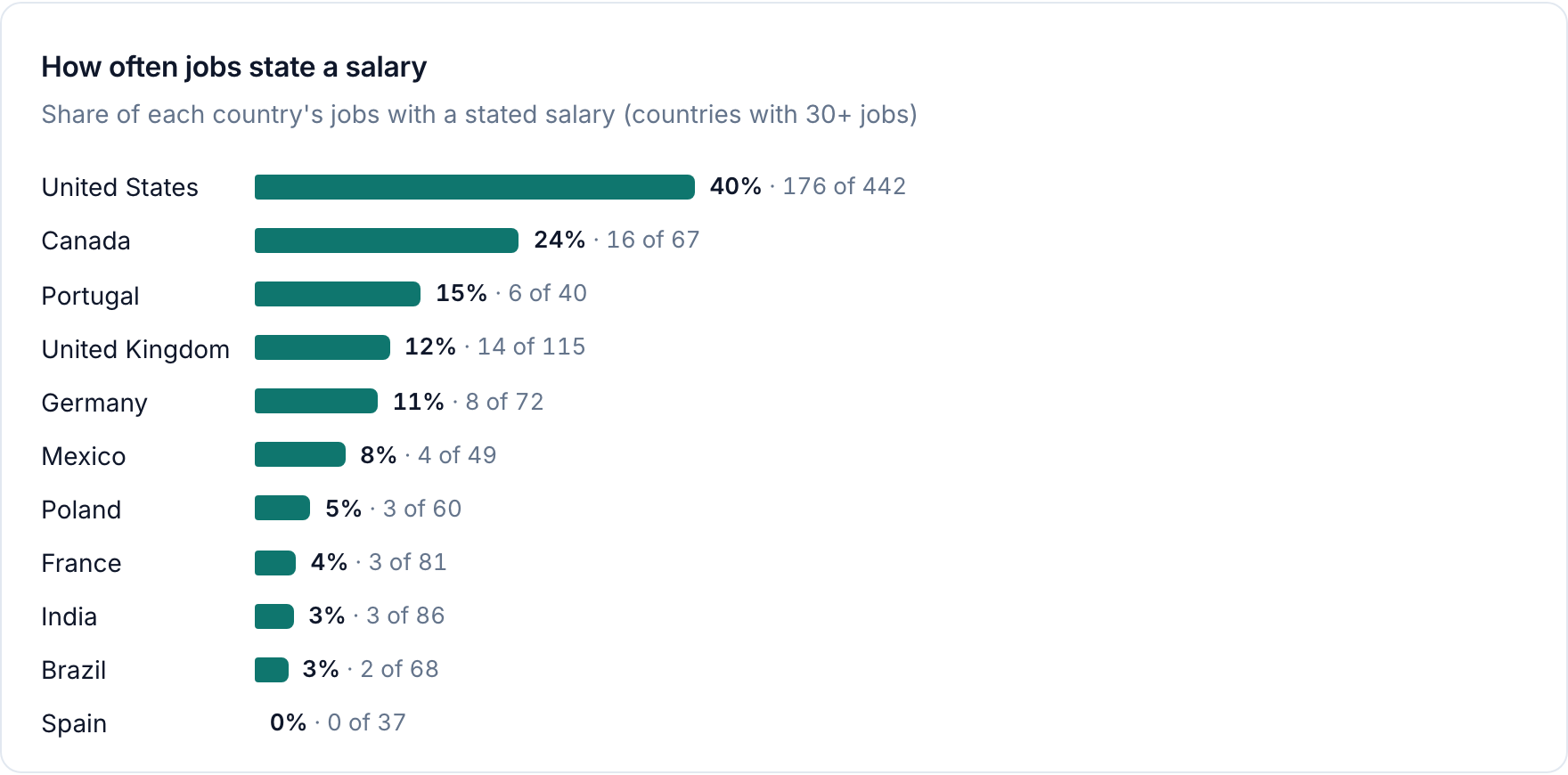
Most stated salaries come from the US, so a global median would mostly reflect US pay. Here instead is US pay by level, for levels with at least 10 jobs that state a salary. Each salary counts as the midpoint of its stated range, as annual base pay in USD, with contractor rates left out:
| US, by level | Jobs with salary | 25th percentile | Median | 75th percentile |
|---|---|---|---|---|
| Junior | 13 | $117k | $155k | $163k |
| Mid | 46 | $135k | $159k | $183k |
| Senior | 72 | $158k | $184k | $215k |
| Staff | 10 | $214k | $235k | $288k |
| Principal | 11 | $209k | $273k | $361k |
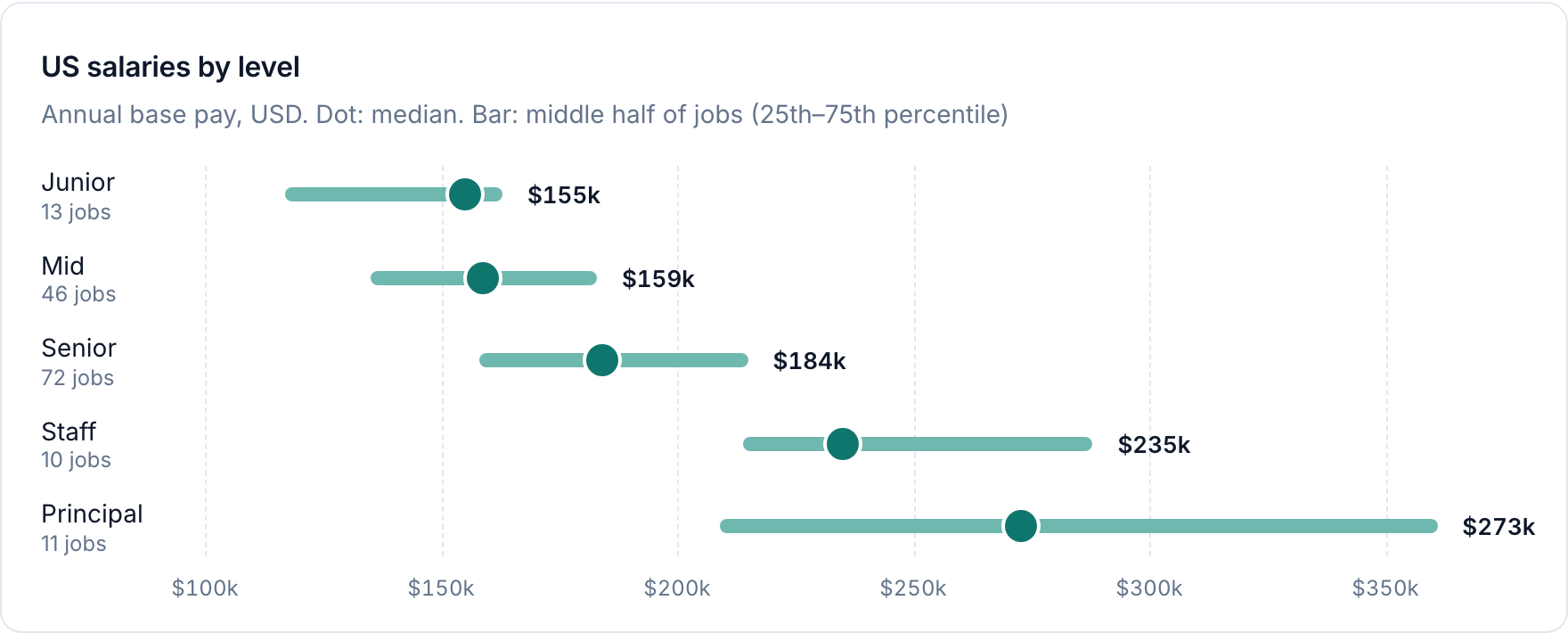
The junior and staff figures rest on a dozen jobs each, so treat them as rough. The junior median is pulled up by a few ML-infrastructure roles at startups and large tech companies paying $160k–205k. Outside the US, the samples are small: the median in Canada was about CA$150k (15 jobs), in the UK about £69k (14 jobs) and in the Netherlands about €88k (10 jobs).
Visa sponsorship and relocation
Only 138 jobs (8%) say anything about visa sponsorship: 40 offer it and 98 rule it out. Relocation support is mentioned in 48 jobs, 42 of them offering it. If you need sponsorship, assume you’ll have to ask, and treat the jobs that state it up front as the exceptions.

Who’s hiring
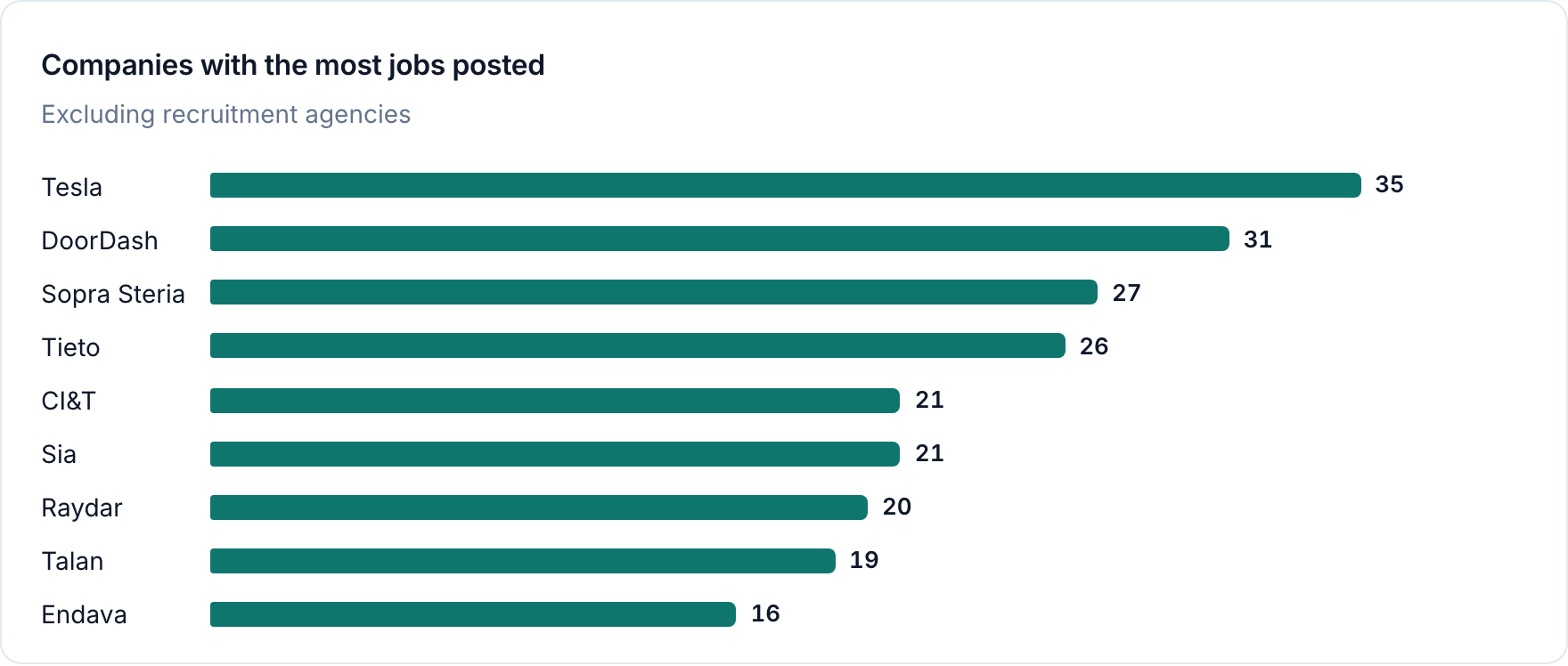
The companies with the most data engineering jobs posted in October were Tesla (35), DoorDash (31), Sopra Steria (27), Tieto (26), CI&T and Sia (21 each), Raydar (20) and Talan (19). Consulting and IT services firms make up the largest industry group we could identify (186 jobs), followed by fintech (96) and SaaS (62). Recruitment agencies posted 40 of the jobs (2%).
How we counted
- What’s included: jobs whose employer-stated posting date falls in October 2026 and that passed our moderation as genuine data engineering roles (data engineering, analytics engineering, data platform and infrastructure, DataOps and MLOps). Jobs that have since closed are included. A job posted on several sites counts once.
- Coverage: these are the jobs our sources reach: company career pages, ATS boards, job boards and Hacker News “Who’s Hiring”. It isn’t the whole market. LinkedIn and Indeed, for example, aren’t included. We added sources during October, so later months will cover more, and we’ll be careful when comparing months.
- Attributes: technologies, seniority, salary and the rest are extracted from each description and normalized, for example “PySpark” and “Apache Spark” both count as Spark. Nothing is inferred: a job that doesn’t state its salary or visa policy counts as “not specified”.
- Salaries: stated ranges, converted to annual USD at recent exchange rates for comparison; local-currency figures use the rates of 7 November 2026.
We’ll publish this report every month. To get new data engineering jobs every week, with the ones that state their salary and stack first, subscribe to the weekly Digest. Or browse all jobs.