 get
How to Stand Out as a Data Engineer
Resume lessons from an OpenAI recruiter on what gets noticed in a 10–15 second scan, and what gets you rejected.1. Insights from the Hiring Frontlines at OpenAI
By Adyl · · 9 min read
1. Insights from the Hiring Frontlines at OpenAI
Data engineering has become a backbone of modern enterprise and AI infrastructure, and the number of applicants for high-impact roles has grown with it. Standing out takes more than packing a PDF with framework keywords. You need to understand how recruiters actually evaluate profiles.
This guide draws on insights from Omari Cely, a Recruiting Partner at OpenAI, speaking from an independent educational perspective. Cely has 16 years of recruiting experience, a decade of it focused on data engineering, and he built OpenAI’s data engineering recruiting strategy and team from zero to one, including hiring technical leaders such as Shin Ram, whom he previously worked with at Netflix.
What a recruiter’s pipeline looks like
- Scale: A single data engineering recruiter often supports 13+ engineering managers and domain pods.
- Volume: Tens of thousands of inbound applications, plus sourced candidates and employee referrals.
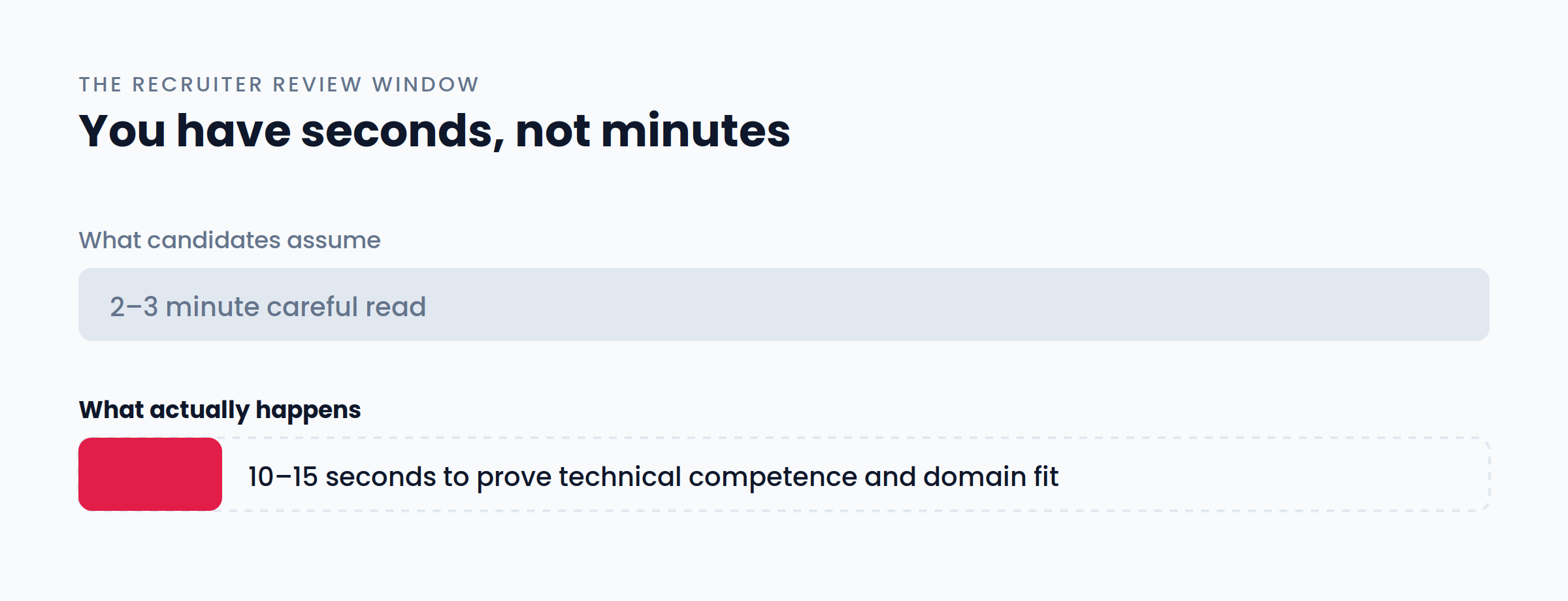
- Review window: Candidates assume a careful 2–3 minute read. In reality, you have 10–15 seconds to show technical competence and domain fit.
Everything that follows is about making those seconds count.
2. The Four Pillars of a Standout Resume
No resume can match every job description. Strong candidates build around four pillars: Relevance, Clarity, Impact, and Credibility.
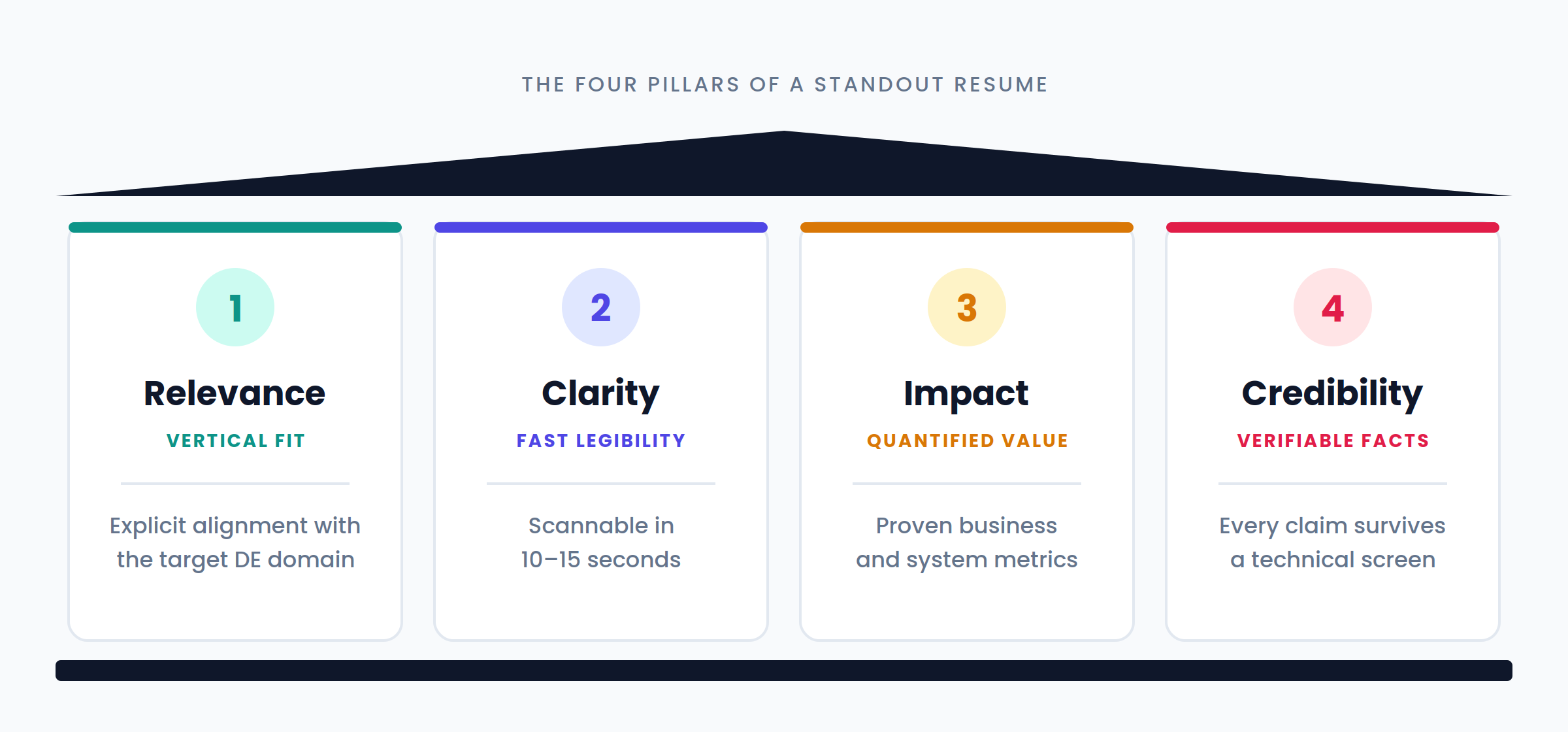
| Pillar | What it means | How to apply it | Pitfall to avoid |
|---|---|---|---|
| Relevance | Direct fit with the target data engineering vertical | Tailor your content to data engineering. If you’re coming from an adjacent role, surface DE certificates, volunteer work, or data projects. | Sending a front-end-leaning or generic software engineering resume |
| Clarity | Readable within 10–15 seconds | Put your most impactful work at the top of page one. Keep it to two pages, even with 20+ years of experience. | Repetition, such as listing the same tools in both the summary and the skills section |
| Impact | Technical work translated into business outcomes | Show concrete metrics, such as millions saved in GPU/infrastructure costs or a percentage drop in pipeline incidents. | Listing responsibilities or tasks without scale or outcomes |
| Credibility | Every claim holds up | Back every tool, architecture claim, and metric with evidence that survives a technical screen. | Inflating your involvement or listing frameworks you can’t defend |
Tailor to the 3–5 must-haves
A common mistake is trying to address every line of a job description. Instead, identify its 3–5 hard requirements, set the nice-to-haves aside, and put direct evidence of those requirements at the top of your resume. That is what the recruiter will see in the first scan.
Keywords and ATS
At this volume, applicant tracking systems (ATS) and AI screening help filter and rank candidates, so technical keywords such as Spark, Scala, Python, SQL, and Maestro matter.
They matter most when your title doesn’t say “Data Engineer.” Many engineers who build pipelines and data platforms hold a generic “Software Engineer” title. Naming your orchestration, compute, and query tools explicitly lets recruiters recognize your data engineering depth instead of filtering you out by title.
3. Writing Bullets: Action, Scope, Impact
Every bullet on a data engineering resume should have three parts.
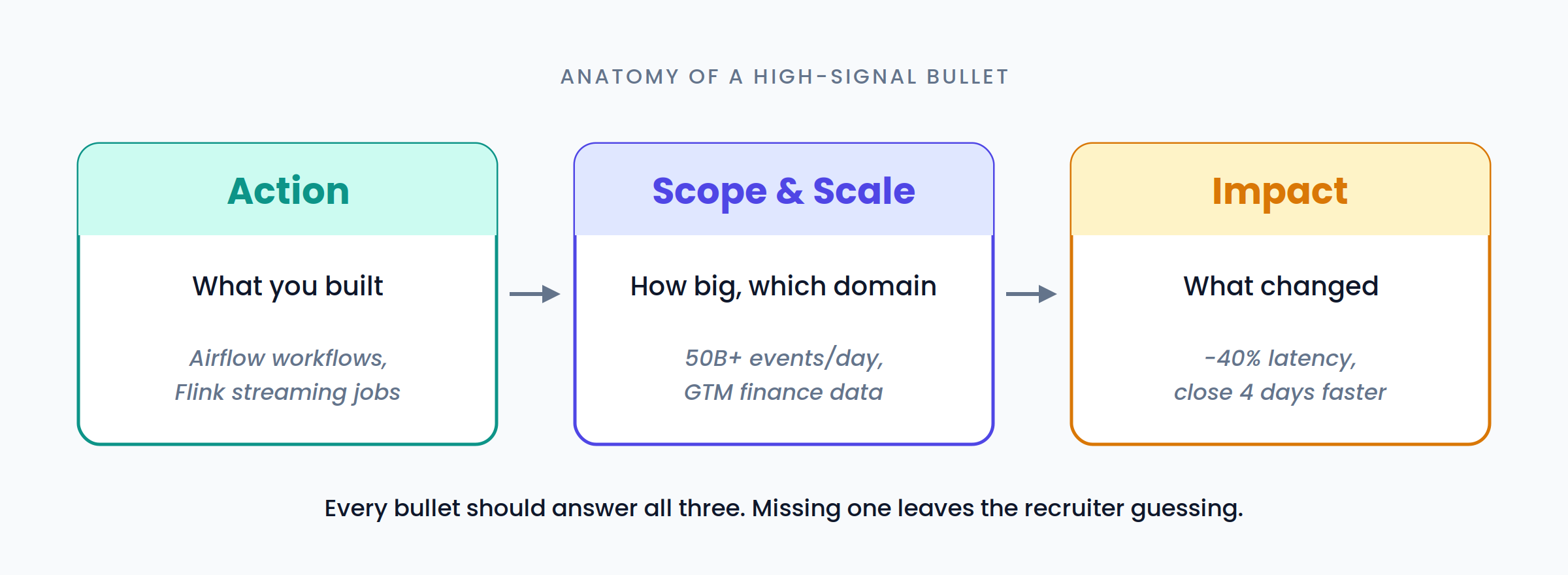
- Action: The specific technical work (e.g., engineered Airflow workflows, built Flink streaming jobs, architected distributed storage).
- Scope & scale: Data volume, velocity, and boundaries. Large numbers (petabytes of storage, 50 billion events per hour) are an instant signal, but smaller or niche domains such as people analytics, real estate, or workplace operations are fine as long as you name the domain.
- Impact: Business value, reliability gains, a better user experience, or lower infrastructure costs.
Before and after
| Original bullet | What’s missing | Rewritten bullet |
|---|---|---|
| Engineered Airflow workflows unifying contract, sales, and finance data, reducing data processing pipeline incidents by 35%. | Context. A 35% drop in incidents is good, but the recruiter has to guess the domain (Go-To-Market / revenue engineering), and the broader business result is missing. | Engineered core Airflow workflows across Go-To-Market (GTM) systems unifying contract, sales, and finance data; reduced pipeline incidents by 35% and shortened the quarterly financial close by 4 business days. |
| Built Flink jobs for high-velocity event data processing. | Scale and impact. It shows Flink and streaming experience, but not how big the system is or what it changed. | Built distributed Flink streaming jobs processing 50B+ daily user events for real-time personalization, cutting endpoint latency by 40% and eliminating streaming SLA breaches. |
Strong bullets prove you can execute. For senior roles, you also need to show how your responsibilities have grown.
4. Show Growth and Ownership
Recruiters and engineering leaders look for steady growth and ownership. Beyond title progression (Data Engineer → Senior Data Engineer → Staff Data Engineer), your wording should signal leadership, not task completion.
“Led” vs. “Contributed to”
- Passive verbs (“contributed to,” “assisted with,” “maintained”) suggest you carried out delegated tasks inside an existing architecture.
- Ownership verbs (“led,” “built from zero to one,” “created canonical data sources”) signal design authority and the ability to take a project from ambiguity to delivery.
The zero-to-one differentiator
At high-growth companies like OpenAI, comfort with ambiguous, zero-to-one work is a top differentiator. Data engineering pods often need someone to be the first or primary data engineer on a new initiative. If you built infrastructure from scratch, set up the first pipelines, or authored canonical data models, say so. It sets you apart from candidates who have only maintained mature systems.
Transferable skills
If you’re moving from front-end or generalist engineering, frame what transfers. Building custom dashboards and bespoke data visualizations, rather than relying only on off-the-shelf BI tools like Looker, is relevant engineering experience. As AI tools like Codex take over boilerplate code and standard dashboards, the ability to build custom interfaces and complex visualization tools remains valuable.
The question recruiters will ask
Prepare for this one in phone screens:
“Who is consuming your datasets, and what are they doing with that data?”
| Example answer | What it signals | |
|---|---|---|
| ❌ Low signal | “Data scientists and ML researchers use my tables to build models.” | Passive pipeline work with little business context |
| ✅ High signal | “ML research teams use these canonical feature store datasets to train model safety classifiers, which cut platform moderation latency by 120 ms.” | End-to-end ownership and real understanding of the domain |
Knowing how your data is used downstream matters even more when you position yourself for a specific domain.
5. Domains, Career Pivots, and Employment Gaps
Name your domain
Data engineering isn’t monolithic. In large organizations, DE pods are usually aligned with business verticals such as:
- Growth accounting and financial systems
- Core product analytics
- Ads and monetization
- Infrastructure and compute capacity (e.g., GPU/cluster analytics)
- Device and hardware analytics
- Trust & safety / platform integrity
- Real estate and workplace operations
State your domain in your experience section, for example “Data Engineer – Infrastructure Capacity” or “Data Engineer – Trust & Safety.” A recruiter supporting 13+ managers can then route your profile straight to the right pod.
Pivot internally first
Top companies hiring senior data engineers, often requiring 8+ years of experience, rarely hire external candidates without hands-on data engineering experience.
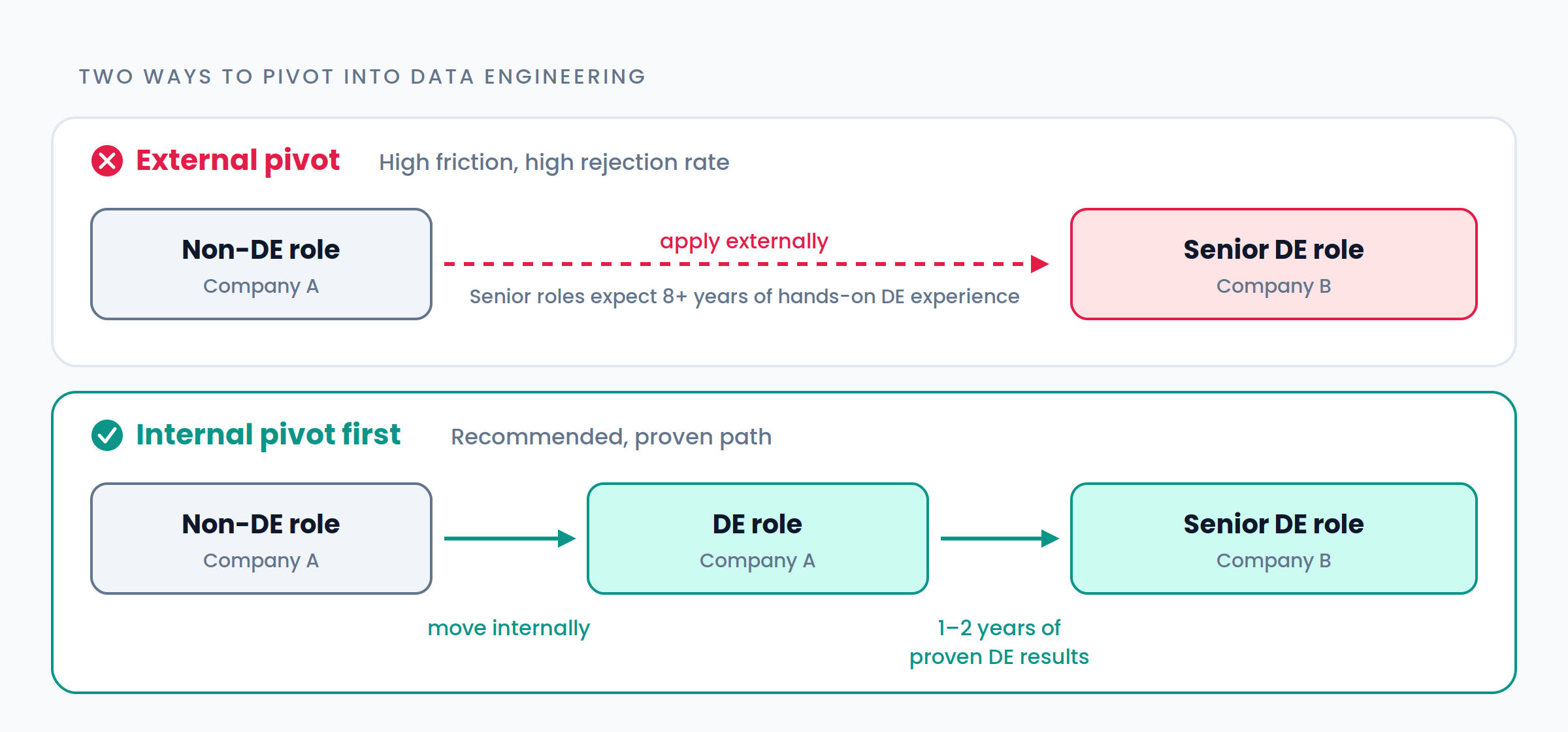
The more reliable path is an internal pivot: move into a data engineering role at your current company, where your domain knowledge and context already count. After 1–2 years of verifiable data engineering results, you’ll be in a strong position for external roles.
Employment gaps and date accuracy
Gaps and short tenures happen because of sabbaticals, family care, personal development, or market conditions. Follow two rules:
- Context is optional. A brief note such as Personal sabbatical or Family care is fine, but you don’t have to explain.
- Dates must be exact. Late-stage hiring includes third-party employment verification that compares your start and end dates against payroll and tax records. Discrepancies raise red flags and can get an offer rescinded.
6. Three Checks Before You Submit
1. The focus check
- Is your most relevant, high-impact evidence in the top third of page one?
- Does the resume target the job’s 3–5 must-have requirements?
- Have you cut redundant summaries and generic tool lists?
2. The truth check
- Is every framework, data volume, and metric accurate?
- Could you defend every bullet in a technical deep dive with a recruiter or hiring manager?
- Have you removed AI-inflated phrasing and claims you can’t back up?
3. The file check
- Are start and end dates accurate to the month and year?
- Do all links work? Links to published papers, YouTube tech talks, or conference talks get technical recruiters excited.
7. Use AI as a Coach, Not a Ghostwriter
AI tools can help you polish a resume, but used carelessly they undermine your credibility.
| AI as a ghostwriter (high risk) | AI as a coach (high signal) |
|---|---|
| Generates unverified claims | Flags clunky phrasing |
| Introduces hallucinations | Checks jargon density |
| Inflates technical scope | Points out missing context |
| Leads to failed screens and permanent recruiter notes | Leaves you in control of the facts |
When AI writes your bullets, it tends to add buzzwords, exaggerated claims, and outright hallucinations. If what you say in a phone screen contradicts your resume, recruiters will fail you and leave notes in the ATS that can follow your future applications.
Used as an editor instead, AI improves readability and catches gaps while you stay in full control of the facts.
A practical workflow
When polishing your resume with tools like ChatGPT or Codex:
- Find wordiness. Ask the model to flag run-on sentences, redundancy, and passive voice.
- Check clarity. Ask whether an outside reader could understand your domain without guessing.
- Stay in control. Review every suggestion line by line, verify that it’s accurate, and never paste confidential or proprietary company data into a public LLM.
8. Conclusion
Standing out doesn’t require resume tricks or inflated claims. It requires treating your resume as a precisely engineered document that communicates technical value quickly:
- Relevance: Map the top of your resume to the job’s 3–5 core requirements and name your domain.
- Clarity: Lead with your best work, keep it to two pages, and cut repetition.
- Impact: Write every bullet as Action, Scope, Impact, with real metrics and downstream context.
- Credibility: Make every claim defensible and every date exact.
Do this, run the three checks before you hit submit, and you’ll give yourself the best chance of clearing high-volume screens at the companies you want to join.